Expanding vocabulary in high school sets students up for success across reading, writing, and test performance. The following hand-picked workbooks focus on roots, spelling, word-building, and context clues to help teens unlock richer meanings and improve fluency. Each product is designed to be used independently or alongside class curricula, offering structured practice, reproducible activities, and progression-friendly formats.
| Product | Key Focus | Best For |
|---|---|---|
| Vocabulary Packets: Greek & Latin Roots | Root words, vocabulary meaning, puzzles | High school students building etymology knowledge |
| Spectrum Spelling Workbook Grade 6 | Spelling patterns, prefixes, suffixes, grammar | Spelling and word-form skills aligned with standards |
| Daily Word Ladders | Word-building, spelling, phonics, vocabulary | Independent practice with progressive word challenges |
| Spectrum Grade 4 Vocabulary Workbook | Word relationships, context clues, roots and affixes | Foundational to mid-level vocabulary growth |
| Evan-Moor Vocabulary Fundamentals | Root words, synonyms, antonyms, idioms | Comprehensive vocabulary foundations for older students |
The list below highlights five suitable options drawn from the available selections, each with a concise overview to help you compare features and fit for your program.
Scholastic Vocabulary Packets: Greek & Latin Roots

The Scholastic Vocabulary Packets focus on Greek and Latin roots to unlock the meaning of dozens of vocabulary words. It uses crossword puzzles and word searches to make practice engaging, reinforcing how understanding roots can illuminate new terms. Ideal for students who struggle with unfamiliar word parts, this resource helps build a transferable base for reading comprehension and test performance.
Spectrum Spelling Workbook Grade 6

The Spectrum Spelling Workbook for Grade 6 offers structured practice in spelling patterns, root words, prefixes, and suffixes, alongside grammar connections. The program aligns with current state standards and reinforces spelling skills within meaningful word contexts. This workbook is suitable for reinforcing classroom lessons and for independent practice to strengthen overall literacy.
Daily Word Ladders: Grades 4-6

Daily Word Ladders provides 100 reproducible lessons designed to boost reading, vocabulary, spelling, and phonics. The ladder-style activities challenge students to climb through clues and letter changes to form new words, promoting engagement and independent practice. This format supports progressive skill development and can be used as a warm-up or extension activity in literacy blocks.
Spectrum Grade 4 Vocabulary Workbook
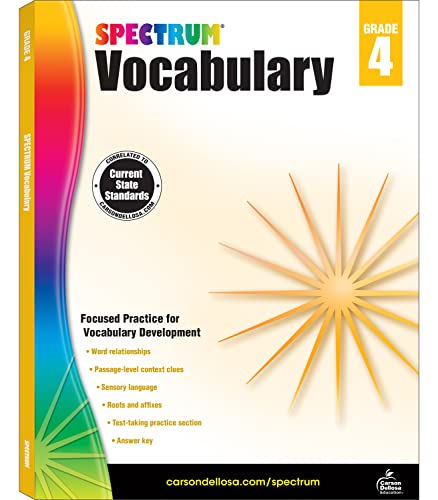
Spectrum Grade 4 Vocabulary Workbook emphasizes word relationships, context clues, sensory language, and roots and affixes. While crafted for fourth grade, the content remains relevant for foundational vocabulary development and can support high school readers who need to strengthen basic word knowledge, inference skills, and reading comprehension strategies.
Evan-Moor Vocabulary Fundamentals

Evan-Moor Vocabulary Fundamentals provides grade-appropriate practice with word roots, synonyms, antonyms, and idioms. The resource emphasizes reproducible worksheets and a broad exposure to essential vocabulary components, offering a solid core for students preparing for higher-level reading and writing tasks. It is designed for both classroom use and homeschool settings, making it versatile for diverse learning environments.
Buying Guide: Key Purchase Considerations
- Curriculum alignment: Check each workbook’s alignment with grade-level standards and how it complements your existing curriculum or remediation plan.
- Skill focus: Decide which aspects to emphasize—roots and etymology, spelling, context clues, or synonyms and antonyms—based on student needs.
- Practice format: Reproducible worksheets, teacher guides, and independent activities offer different levels of classroom practicality and student autonomy.
- Pacing and progression: Look for resources that provide gradual difficulty increases, allowing steady growth over a term or semester.
- Differentiation options: Consider whether the workbook includes blank or extension activities to help advanced learners or to scaffold difficulties for struggling readers.
- Assessments and progress tracking: Materials that include answer keys or quick assessments help monitor improvement and adjust instruction.
- Independent versus guided use: Some books are designed for independent practice, while others assume teacher-led instruction or structured classroom time.
- Adaptability: Materials that support both classroom and homeschool contexts offer greater flexibility for families and schools with variable schedules.
- Cost and volume: If buying for a cohort, examine whether the set offers enough reproducible pages to minimize duplication and fatigue.
When choosing vocabulary resources for high school students, balance foundational skills with more advanced word-work. Integrating root-word study, context-based meaning, and spelling practice creates a robust vocabulary development plan. Consider pairing one core workbook with supplementary activities that target specific gaps, such as word relationship skills or morphological analysis, to maximize growth and comprehension across subjects.