If you want quick access to essential chords, keys, and fingerings, this guide highlights top ukulele chord books designed for learners and seasoned players alike. Each pick focuses on clear diagrams, practical voicings, and portable references that fit into cases or pockets. This selection helps beginners build a solid foundation and gives more advanced players handy reference tools for on-the-go practice.
Buyer type overview: beginner players often benefit from compact, dictionary-like guides with large diagrams and straightforward explanations. Intermediate players may prefer chord chart references with many voicings. Song-focused readers look for chord books that pair with familiar tunes. The table below summarizes five strong options and what they’re best for.
| Product | Best For | Key Benefit | Format |
|---|---|---|---|
| Hal Leonard Ukulele Chord Finder | Beginners seeking 1,000+ chords | Easy-to-use, wide chord coverage | Hardcover/spiral reference |
| Ukulele Chord Dictionary (Alfred Handy Guide) | Travel players and quick lookups | Compact, dictionary-style organization | Pocket-sized guide |
| LookVeeT Ukulele Chord Chart Reference | Beginners to intermediates needing quick diagrams | Clear visuals and broad chord range | A4 chart sheets |
| Ukulele Method Book 1 (Hal Leonard) | Absolute beginners and young learners | Structured lessons with chords and strumming | Printed method book |
| Ukulele Case Chord Book In Full Color | On-the-go practice and quick reference | Colorful, portable chord guides | Softcover booklet |
Hal Leonard Ukulele Chord Finder: Easy Access To 1,000+ Chords

The Hal Leonard Ukulele Chord Finder is designed for players who want a broad repertoire of chord shapes. It presents over 1,000 chords with clear finger positions, making it a strong choice for beginners who need extensive reference material and for players expanding their chord vocabulary. Best for learners who want a single, comprehensive guide to consult while practicing daily.
Best for: newcomers and intermediate players who prefer a large chord library in a single volume. Limitations: not a rhythm or technique guide; it focuses on chord shapes and voicings rather than songs or strumming patterns.
Ukulele Chord Dictionary: Handy Guide
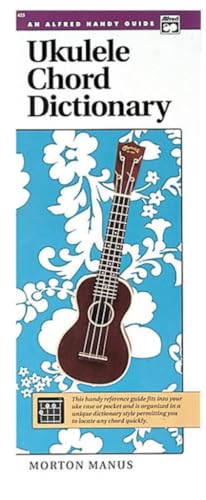
The Ukulele Chord Dictionary from Alfred Publishing is a compact, dictionary-style reference. It’s ideal for players who want quick lookups and a portable chord resource that fits into a case or pocket. It includes sections on reading music, tuning, movable chords, and a fingerboard chart, making it a practical travel companion.
Best for: players who value portability and fast chord retrieval. Caution: as a pocket reference, it provides concise explanations rather than in-depth technique guidance.
LookVeeT Chord Chart Reference (2 Pcs)

The LookVeeT chord charts offer clear diagrams and fingering positions in a compact A4 format. These charts cover a wide range of major, minor, and seventh chords, making them a practical reference for beginners who practice daily and need quick chord shapes at hand. Best for: learners who want easy-to-read diagrams and a portable, dual-pack option for spare copies.
Limitation: charts are reference-only; they do not provide full instruction on rhythm or song structure.
Ukulele Method Book 1

The Hal Leonard Ukulele Method Book 1 is structured for beginners and kids, featuring a step-by-step approach to chords, strumming, and reading music. It’s arranged specifically for ukulele and includes standard notation to help learners bridge to reading staff lines. Best for: new players who benefit from a guided, progressive lesson format with chord practice integrated into songs and exercises.
Better for: families or classrooms seeking a formal progression. Caution: may be too basic for players seeking extensive chord collections beyond the initial lessons.
Ukulele Case Chord Book In Full Color

This chording guide comes in full color and is designed as a compact, portable reference for on-the-go practice. It features chord diagrams with clear colors to help beginners recognize finger positions quickly. Best for: players who want a visually engaging, lightweight reference they can carry in a case. Limitation: as a compact booklet, it may not cover as many voicings as larger reference books.
First 50 Songs You Should Play on Ukulele

This song-focused book provides easy chords paired with lyrics and melodies, making it practical for players aiming to learn songs quickly. Best for: learners who want to practice chord changes in the context of recognizable tunes. Caution: it emphasizes chord shapes within selected songs and may not offer a exhaustive chord library.
Treasury of Ukulele Chords

The Treasury of Ukulele Chords collects a broad range of chords and voicings in a traditional format. Best for: players who want a classic, comprehensive chord reference with a long-standing reputation. Limitation: some editions show older typography and may have fewer modern voicings compared to newer guides.
Buying Guide
What should I look for in a ukulele chord book?
Consider the chord coverage, organization style, and portability. Dictionary-style layouts are great for quick lookups, while method books add instructional structure. If you travel often, a compact, pocket-friendly guide is valuable.
Which format fits my playing level?
Beginners typically benefit from clearly labeled diagrams and an index of chords with easy fingerings. Intermediate players may prefer chord charts with expanded voicings and crossings. Song-focused readers should choose books that pair chords with popular tunes for practice.
How important is portability?
For players who practice away from home, a compact guide or a few foldable chord charts stored in a case are practical. Larger, multi-hundred-page volumes are better when you have a dedicated practice space at home.
Are there any limitations to expect?
Many chord books focus on shapes and diagrams rather than teaching rhythm, strumming patterns, or song arrangements. Some pocket guides may omit advanced voicings or detailed theory in favor of quick reference.
How to choose between a dictionary and a method book?
A dictionary-style guide is ideal when you need rapid chord lookups and a broad range of shapes. A method book suits newcomers who want structured lessons, progression-based practice, and integrated music-reading skills.
How to use these resources effectively?
Combine a chord dictionary with a method book for balanced learning. Use chord charts for on-the-go practice and reference, especially when learning new songs. Regular practice of scales, transitions, and rhythm will complement the chord work from these books.
FAQ
- What is the best all-around ukulele chord book for beginners? A goal-oriented method book paired with a broad chord finder provides both instruction and a wide chord library.
- Do chord dictionaries teach sight-reading? They primarily show fingerings and voicings; supplementary music-reading resources are helpful for sight-reading progress.
- Are color-coded chord charts more effective? Color helps distinguish finger positions and can speed up learning, especially for beginners.
- Can I use these books for self-study? Yes, most are designed for solo practice, though structured lessons in method books support steady progression.
- Should I buy multiple chord books? Yes, a combination provides breadth (voicings) and depth (instruction and song repertoire).
- Is a compact guide sufficient for advanced playing? Advanced players may want larger, comprehensive chord references or music theory guides in addition to compact charts.