Finding age-appropriate STEM books helps preschoolers explore science, technology, engineering, and math through play, hands-on activities, and guided discovery. The following selections combine engaging topics with kid-friendly formats to support early learning at home or in the classroom. Each pick includes practical activities, visuals, and simple tasks designed to spark curiosity while building foundational skills in literacy, numeracy, and problem-solving.
| Product | Brand | Focus |
|---|---|---|
| LeapFrog LeapStart Pre-Kindergarten Activity Book: Pre-K STEM | LeapFrog | STEM, teamwork, problem solving |
| Scholastic Storytime STEM Nursery Rhymes Book | Scholastic | STEM activities tied to nursery rhymes |
| Preschool Learning Activities – Tracing Books | Momo & Nashi | Fine motor, letter tracing, early writing |
| School Zone Thinking Skills Workbook | School Zone | Logic, problem-solving, early reasoning |
| The Everything Kids’ Science Experiments Book | Simon & Schuster | Hands-on experiments, science exploration |
The selected titles provide a range of formats—from interactive activity books and rhymes-based STEM tasks to tracing workbooks and experiment guides—ensuring there is something for every preschool learner. They emphasize safe, age-appropriate activities that promote curiosity, vocabulary growth, fine motor development, and early scientific thinking. Each product aligns with a gentle, play-centered approach to early STEM education, helping caregivers and teachers integrate science concepts into daily routines.
LeapFrog LeapStart Pre-Kindergarten STEM Activity Book

LeapFrog’s LeapStart series blends interaction with foundational STEM concepts. This Pre-K STEM activity book leverages the LeapStart system to guide early learners through 16 pre-kindergarten STEM skills, including reading simple graphs, experimenting with trial and error, and using tools to solve problems. It features 40+ replayable activities and 25+ reward stickers, encouraging repetition and positive reinforcement while fostering teamwork and communication through guided tasks. The content is designed to support early literacy and critical thinking in a structured, kid-friendly format that integrates with the LeapStart platform.
Scholastic Storytime STEM Nursery Rhymes Book

This nursery rhymes book from Scholastic weaves STEM activities into familiar verses, offering a natural transition from reading to hands-on exploration. Each rhyme provides three STEM activities, making it easy for caregivers to incorporate short, focused investigations into daily routines. The book also aligns with Next Generation Science Standards, supporting early science concepts for preschool and kindergarten readiness. The format is approachable for small-group reading sessions or independent exploration, helping children connect language with STEM ideas through playful prompts.
Preschool Learning Activities – Tracing Books for Kids Ages 3-5
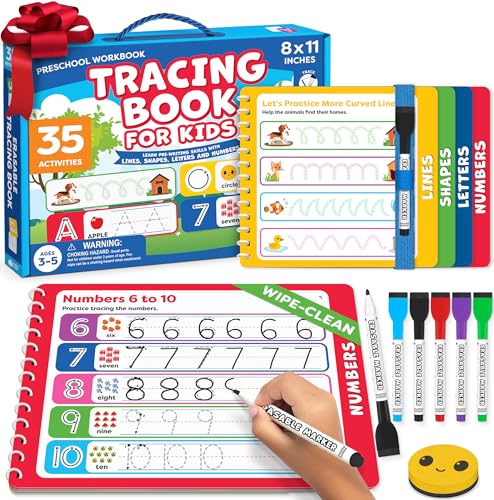
This tracing-focused workbook set from Momo & Nashi combines dry-erase functionality with durable materials to support independent practice. It includes six colorful markers, a smiley eraser, and a storage box, enabling repeated use without additional tools. The activities emphasize letter tracing, shapes, lines, and numbers 1-10, supporting early handwriting, stroke recognition, color sorting, memory, and coordination. The dry-erase format makes it ideal for daily short sessions, homeschool use, daycare activities, or Montessori-style settings, with ADHD-friendly considerations for focused learning.
School Zone Thinking Skills Workbook

The School Zone Thinking Skills Workbook focuses on early problem-solving and logic development for preschool and kindergarten children. It offers structured activities designed to boost critical thinking, pattern recognition, sequencing, and basic deduction. The workbook format supports short, guided sessions, making it appropriate for classroom centers or at-home practice. While concise in description, the book emphasizes essential cognitive skills that lay the groundwork for mathematical reasoning and scientific inquiry as children progress in school.
The Everything Kids’ Science Experiments Book
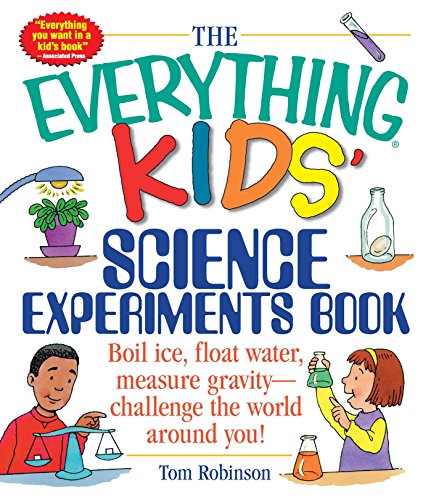
In this hands-on science collection, children can explore a wide range of simple experiments tailored for curious minds. With approachable explanations and kid-friendly activities, the book encourages experimentation, observation, and measurement. The experimentation prompts cover topics such as physics, chemistry, and earth science, making it a versatile resource for classroom centers or home science corners. The activities are designed to be engaging without requiring specialized equipment, promoting safe, independent exploration and collaborative inquiry with peers or caregivers.
Buying Guide
Key factors to consider when choosing STEM books for preschoolers:
- Age appropriateness: Select formats that match attention spans and fine motor abilities typical of ages 3–5.
- Hands-on opportunities: Look for activities that involve physically manipulating objects, drawing, tracing, or simple experiments.
- Teacher or caregiver guidance: Some books include structured prompts or standards alignment, while others encourage free exploration.
- Integration with technology: If you own interactive systems (like LeapStart), check compatibility to maximize engagement.
- Diversity of skills: Mix books focusing on science concepts with ones that build literacy, writing, and logical thinking.
- Durability and reuse: Dry-erase or reusable pages extend the lifespan of learning materials for multiple sessions.
Comparing Formats
- Interactive activity books: Best for guided exploration and immediate feedback; often pair with a system or prompts.
- Story-based STEM books: Great for language development and introducing concepts within a narrative context.
- Tracing and handwriting workbooks: Support fine motor skills and early writing—foundational for STEM note-taking.
- Logic and puzzle workbooks: Build critical thinking and problem-solving readiness for later math and science.
- Hands-on experiment guides: Encourage independent or small-group inquiry with tangible results and observations.
When selecting titles, consider a balance between guided activities and open-ended exploration. A small library of varied formats can support a broad range of STEM skills, from observation and hypothesis to measurement and recording, helping preschoolers build readiness for later academic success. It’s also helpful to incorporate everyday STEM moments—cooking, building with blocks, gardening, or nature walks—to reinforce concepts in a familiar context.