Discover effective social story books and related tools designed to support children on the autism spectrum. This guide highlights five educational resources that use picture cards, storytelling prompts, and emotion-flled activities to foster communication, emotional literacy, and social skills. Each entry summarizes core features and practical uses, helping caregivers select materials that suit homeschooling, therapy, or classroom settings.
Summary of Selected Products
| Product | Brand | Key Focus | Format |
|---|---|---|---|
| Picture Book and Emotion Cards, WH Question Flipbook | SPARK INNOVATIONS | WH questions, sentence building, emotions | Busy book with cards |
| Picture Book and Emotion Cards #2 | SPARK INNOVATIONS | Storytelling, emotion lessons, social skills | Flipbook busy book |
| The Social Skills Picture Book | Future Horizons | Play, emotion, communication | Printed picture book |
| Autism & Prosperity Emotions & Life Skills Set | Autism & Prosperity | Emotion understanding, social life skills | Learning materials bundle |
Picture Book and Emotion Cards: WH Question Flipbook

The first SPARK INNOVATIONS title centers on a busy-book format with picture cards designed to aid WH questions and sentence building. It supports storytelling, creative thinking, and problem solving while presenting detailed scenes that illustrate emotions and social situations. The materials aim to promote self-esteem and social skills by guiding children to recognize cues in switching emotional states and responding to different social contexts. The flipbook structure supports repeated practice and reinforcement, suitable for home schooling or therapy sessions.
Key uses include improving language skills, fostering emotional literacy, and building coping strategies through prompts that encourage critical thinking. The kit emphasizes relatable scenes and ESL/ELL-friendly prompts, helping learners label feelings such as anger, sadness, happiness, and frustration. Educators and parents can use it to scaffold conversations about emotions, situations, and appropriate responses. The product is especially useful for children who benefit from visual supports and concrete examples.
Picture Book and Emotion Cards #2: Storytelling And Social Skills

The second SPARK INNOVATIONS title mirrors the first format with an emphasis on social-emotional learning and sentence construction. It promotes storytelling and creative problem solving using picture-based prompts. The content highlights diverse emotions and social scenarios to teach kids how to respond in varied contexts, with a focus on developing social competencies alongside language skills. The flipbook design supports ongoing repetition, making it suitable for daily practice in family routines or small-group instruction.
In practice, caregivers can guide children through scenes that illustrate emotional states and social dynamics. The prompts encourage reflective thinking, helping learners articulate feelings and plan responses. This resource aligns with speech therapy activities and ESL/ELL goals, providing clear visuals paired with concise language that facilitates comprehension and expressive communication.
The Social Skills Picture Book: Teaching Play, Emotion, and Communication

Future Horizons presents a straightforward print resource focused on teaching play, emotion, and communication to children with autism. Although described as a used book in good condition, its timeless approach continues to serve classrooms and therapy settings. The content centers on practical, observable behaviors and social scripts, offering scenarios and examples that help learners interpret social cues, request assistance, and engage in reciprocal interactions. It is most effective when paired with guided discussion and role-playing activities.
This title supports foundational social understanding, including turn-taking, sharing, and recognizing emotions in others. Educators can leverage it to build structured lessons, reinforce positive social behaviors, and reinforce language targets through real-life contexts. The clear visuals and concise text make it accessible for readers with varying levels of language proficiency.
Autism & Prosperity Emotions & Life Skills Set
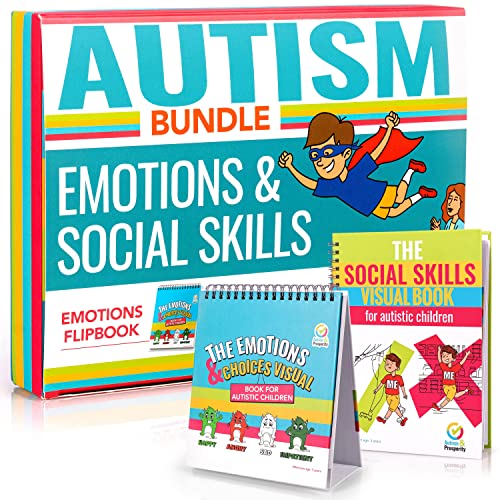
This set from Autism & Prosperity emphasizes ultra-visual social skills instruction and emotion understanding tailored for autistic learners. The bundle is designed to help children recognize and express feelings, navigate social situations, and build small steps toward independence, such as interacting with peers and managing conflicts. The materials are positioned as supportive tools for parents and caregivers seeking practical adaptations for daily routines, school activities, and social events.
Features focus on reducing challenging behaviors through clear emotional labeling and structured prompts. The resources are intended to be engaging and approachable for a broad age range, including toddlers to older children. The set can function as a core component of a comprehensive social skills program, integrated with language development activities and visual schedules to reinforce consistent learning outcomes.
Buying Guide: Key Purchase Considerations For Social Story Tools
- Learning objectives: Align materials with specific targets such as emotion recognition, language expansion, or social problem solving. Choose tools that explicitly address those goals rather than generic content.
- Visual supports: Look for clear images, simple text, and consistent formats. Visual cues help learners process social scenarios more effectively than text alone.
- Format and durability: Consider whether a busy-book, flipbook, or printed picture book fits the child’s environment (home, school, or clinic). Durable materials support long-term use and repeated practice.
- Age and development level: Select resources that match cognitive and language abilities. Some sets are designed for early learners, while others target school-age children with more complex prompts.
- Therapy alignment: If utilized in a therapy setting, ensure the materials support speech-language goals and can be integrated with established prompts and activities.
- Caregiver guidance: Materials with structured lesson ideas, prompts, and suggested activities tend to be easier to implement consistently in daily routines.
- Accessibility and inclusivity: Favor resources that depict diverse emotions, scenarios, and characters to foster empathy and broader social understanding.
- Budget and value: Compare the number of activities and reuse potential. Busy books and flipbooks typically offer higher reusability for varied sessions.
- Safety and age-appropriateness: Verify that materials are suitable for the child’s age and do not include elements that could pose a risk in unsupervised settings.
- Reviews and success signals: Look for evidence of practical success in homeschool, classroom, or therapy contexts, such as caregiver reports or clinician recommendations.