Finding engaging daily questions for kids can boost listening, speaking, and emotional intelligence while making classroom and family time more lively. This article highlights a curated set of question cards and journals designed to prompt meaningful discussions, improve vocabulary, and build stronger connections among young learners. Read on for realistic options that support social skills, communication, and reflective thinking in children.
Summary of Selected Products
- 100 Morning Meeting Chips Questions Cards for Kids, KMLIFE
- One Question a Day: A Five-Year Journal (St. Martin’s Press)
- TableTopics Kids to Go Conversation Cards for Families (TableTopics)
- TableTopics Kids Conversation Pack for Families (TableTopics)
Product highlights and practical use
What follows is a focused review of four standout question sets that align with a “question a day” approach for kids. Each offers a unique format—chips, journals, or card prompts—designed to stimulate discussion, vocabulary growth, and social-emotional learning in various settings, from classrooms to car rides and dinner tables. The products are listed in a way that prioritizes accessibility, reusability, and age-appropriate prompts for children roughly from early elementary through middle elementary years.
id=”product-1″>100 Morning Meeting Chips: Quick Conversation Prompts

The 100 Morning Meeting Chips from KMLIFE provide compact, double-sided laminated chips designed for daily use with primary students. Each chip is about 2.36 inches in diameter, waterproof, and tear-resistant, making them suitable for classroom displays and quick checks of comprehension or feelings. The kit emphasizes non-repetitive prompts, enabling teachers and parents to explore a broad spectrum of topics—from mood and listening to vocabulary and social skills. The chips also support public speaking practice and reflective thinking, helping students articulate thoughts and respond to peers in meaningful ways.
This set is particularly effective for fostering class cohesion and a sense of community. By routing questions that touch on happiness, integrity, goals, and collaboration, it encourages kids to share perspectives and practice empathy. The structure supports small-group discussions as well as whole-class conversations, providing a simple, low-prep resource for daily use. Each card’s design is intended to help students feel comfortable revealing their thoughts while building confidence in verbal expression.
id=”product-2″>One Question a Day: A Five-Year Journal

The Five-Year Journal offers a personal time capsule of questions and answers designed to be filled over multiple years. It provides a simple, consistent prompt structure that can be used to capture a child’s evolving thoughts, personality, and preferences. While the format is broader than daily classroom prompts, it encourages reflective practice and long-term self-awareness, which complements quick daily questions with deeper introspection. The English-language edition aims for straightforward engagement, allowing kids to articulate answers in a concise and authentic voice.
For homes or classrooms seeking a durable, enduring record of a child’s responses, this journal provides a cadence that supports literacy development and self-expression. It can be used as a nightly prompt or a weekly reflection exercise, giving children a tangible sense of progress and memory across years. The focus is on thoughtful communication rather than rapid-fire answers, helping learners build a habit of clear, thoughtful writing and speaking.
id=”product-3″>TableTopics Kids to Go Conversation Cards

TableTopics’ Kids to Go is a compact set of conversation cards designed for families with young children. With 40 questions ideal for dinner, car trips, or classroom discussions, these prompts aim to spark fun and connection. Sample questions—such as choosing a favorite character, or identifying a fun party memory—encourage creative thinking and expressive language. The product suits multi-player settings and works well as a casual icebreaker during transitions or snack breaks. It is compatible with various group sizes and fosters inclusive participation.
The cards emphasize everyday relevance, helping children articulate preferences, humor, and personal experiences in ways that are accessible to younger speakers. Like other prompt sets, they promote listening, turn-taking, and respectful dialogue, while providing a structure that reduces hesitation when speaking in groups. If you need a portable option for on-the-go conversations, this set delivers a reliable, kid-friendly experience.
id=”product-4″>TableTopics Kids Conversation Pack: 120 Engaging Questions
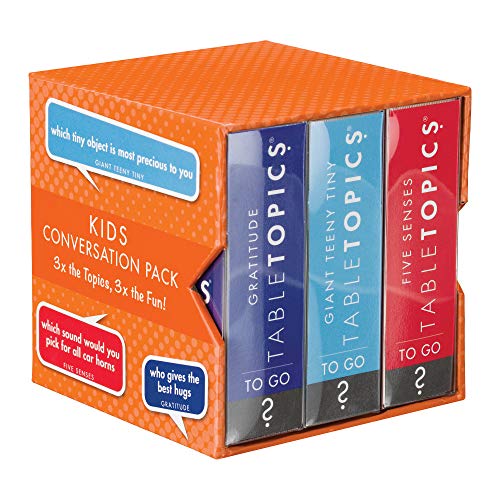
The TableTopics Kids Conversation Pack expands the prompt library with 120 engaging questions organized into three topical sets. It is designed for family dinners and classroom discussions, offering a broader spectrum of prompts to maintain interest and participation. The questions target daily experiences, preferences, and imaginative scenarios, encouraging children to articulate thoughts clearly and listen actively to peers. The boxed set format makes it easy to rotate topics, keep conversations fresh, and use as a stocking stuffer or classroom icebreaker during lessons, assemblies, or group activities.
Across these options, the emphasis remains on accessible language, safe topics, and prompts that invite participation from children with varying communication styles. Each product supports social and emotional learning by offering opportunities to express feelings, justify opinions, and respond to others with empathy and curiosity. Collectively, they provide a flexible toolkit for daily or weekly question-based engagement in both home and school environments.
Buying Guide: Key Purchase Considerations
- Age range and language level: Choose prompts aligned with your child’s or students’ developmental stage and vocabulary.
- Format and durability: Cards and chips should be easy to handle, clearly printed, and resistant to wear for repeated use.
- Settings and portability: Consider whether you need in-classroom use, car rides, or home dinner-time prompts, and select formats accordingly.
- Social-emotional focus: Look for prompts that encourage listening, empathy, collaboration, and respectful dialogue alongside language practice.
- Volume and variety: A larger pool of questions reduces repetition and keeps conversations engaging over time.
- Longevity and adaptability: Journal-style prompts offer long-term reflection, while quick chips or cards support daily interactions.
- Design and accessibility: Clear typography and inclusive topics help all children participate meaningfully.