Finding effective phonics resources for first graders can make a big difference in reading confidence and classroom success. This guide highlights five well-regarded phonics books and workbooks designed for 1st grade, featuring structured practice, engaging activities, and clear progress paths. Each pick is suitable for independent study, classroom use, or homeschooling, and aligns with common early reading standards.
Summary of Selected Products
- School Zone Big First Grade Workbook — 320 pages, comprehensive first-grade curriculum
- Spectrum 1st Grade Phonics Workbook — focused phonics and sentence writing practice
- 100 Words Kids Need to Read by 1st Grade — essential sight word practice
- Evan-Moor Daily Phonics, Grade 1 — daily phonemic awareness and decoding
- Carson Dellosa All the Skills for First Grade Workbook — crossing phonics with math and writing
School Zone Big First Grade Workbook

The School Zone Big First Grade Workbook offers a broad, classroom-ready package for early literacy and math fundamentals. Its 320 pages are divided into sections covering Phonics, Reading Skills and Parts of Speech, plus core math topics, time, money, fractions, and story problems. Color-coded basics at the bottom of each page help learners track progress and stay organized. This all-in-one format supports structured daily practice, making it a strong choice for teachers and parents seeking a comprehensive 1st-grade resource.
Key features include a clear, gentle progression through foundational skills and easy-to-follow lessons that align with a typical 1st-grade trajectory. The workbook’s broad scope means students can build decoding abilities alongside word-building and basic numeracy. While it provides substantial content, the layout remains accessible for young readers who benefit from color-coding and consistent page design.
Ideal for: young readers needing a broad daily practice solution, or classrooms seeking a single, multipurpose workbook. The format supports structured routines and independent work, with materials that can be easily integrated into a small-group rotation or homeschool schedule.
Spectrum 1st Grade Phonics Workbook
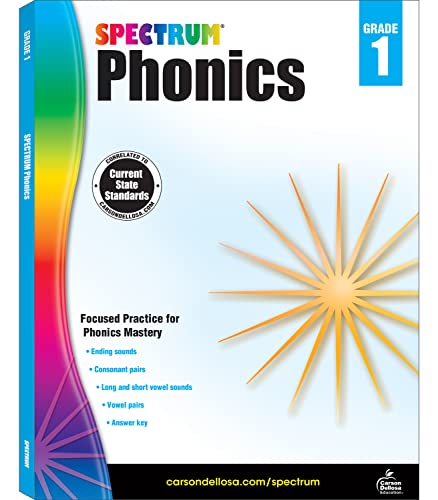
Spectrum’s 1st Grade Phonics Workbook emphasizes practical phonics skills alongside reading readiness. The book reinforces vowel and consonant sounds, ending sounds and word families, and practice with letters, words, and sentence writing. Its structure supports a gradual build in decoding and word-analysis abilities, while integrating comprehension activities and handwriting practice. The workbook is suitable for both classroom and homeschooling contexts, offering structured tasks that reinforce daily phonics routines.
Features focus on: phonics decoding, structural analysis, and dictionary skills, with exercises designed to connect letter sounds to real words. The activities encourage independent practice while supporting teacher-led instruction. The book’s concise units help maintain engagement without overwhelming young readers, making it a versatile component of a broader literacy plan.
Best used as: a targeted phonics supplement within a larger 1st-grade literacy program, or as a focused practice resource for students needing reinforcement in phonics rules and word building.
100 Words Kids Need to Read by 1st Grade

Scholastic’s 100 Words Kids Need to Read by 1st Grade centers on essential sight word practice, reinforcing the core vocabulary that young readers encounter most often. Each workbook reinforces the 100 words children should know by the end of first grade through fill-in-the-blank stories, sentences, word riddles, games, and puzzles. By combining repetition with engaging activities, this resource helps learners recognize high-frequency words quickly, supporting smoother reading fluency and comprehension.
This book is well-suited for both classroom centers and home practice, especially for students who benefit from explicit word recognition strategies. The inclusion of varied activities—stories, puzzles, and games—helps sustain motivation while building automaticity and confidence in reading common words.
Evan-Moor Daily Phonics, Grade 1

Evan-Moor’s Daily Phonics for Grade 1 provides a focused, daily-friendly approach to phonemic awareness, decoding, and word-study. The 208-page workbook is designed for homeschool use or classroom adoption, with reproducible worksheets to support consistent practice. The resource emphasizes phoneme-grapheme mapping, blending, segmenting, and decoding strategies, alongside scaffolding for English learners where applicable.
With a compact page count and a clear progression, this workbook works well as a steady, ongoing practice tool. It is particularly effective when used as part of a daily routine that pairs phonics with reading fluency activities, enabling students to apply decoding skills to regular reading tasks.
Carson Dellosa All the Skills for First Grade Workbook

The Carson Dellosa All the Skills for First Grade Workbook integrates phonics with writing practice and reading activities, offering a well-rounded approach to early literacy development. The volume emphasizes foundational skills in phonics, along with reading comprehension and writing tasks, making it a practical choice for holistically building first-grade literacy competencies. The book is marketed as a classroom or homeschool resource and is designed to support diverse learners across multiple skill areas.
Designed to complement daily instruction, this workbook provides a balanced mix of phonics drills, word work, and writing practice. It can serve as a core component of a literacy block or as supplementary material for students who need additional guided practice in decoding and sentence construction.
Buying Guide: Phonics Resources for 1st Grade
Choosing the right phonics book for a 1st grade learner involves balancing structure, engagement, and skill coverage. Consider these factors to match resources with a child’s needs and a family or classroom program:
- Scope and sequence: Look for materials that cover letter sounds, decoding, sight words, and basic fluency. A mix of phonics drills and reading practice helps reinforce skills across contexts.
- Engagement and format: Young readers benefit from colorful layouts, interactive activities, and varied practice (worksheets, stories, games). Decide whether you prefer print-only resources or those with digital extensions.
- Differentiation: Favor resources that offer options for varied levels, allowing quick learners to advance and providing scaffolds for struggling readers or English learners.
- Reproducibility: If you’re homeschooling or teaching in a classroom, reproducible worksheets can save time and ensure consistent practice for multiple students.
- Integration with other subjects: Some books blend phonics with reading, writing, and math skills, offering a cohesive approach to literacy within a broader curriculum.
- Assessment support: Look for answer keys, progress checks, and suggested activities that help track growth without excessive testing.
Comparisons among these options show that a blend tends to work best: a core phonics workbook paired with a sight-word or reading- fluency resource can address both decoding accuracy and real-word usage. For classrooms, combining a daily phonics plan with a comprehensive workbook helps ensure consistent practice across learners. For homeschool settings, consider the flexibility of a single multipurpose book alongside targeted phonics workbooks to tailor daily lessons to your child’s pace.