Choosing the right books for a four-year-old can support early literacy, cognitive growth, and independent play. This article highlights four carefully selected titles that focus on handwriting readiness, thinking skills, and engaging activities. Each product includes practical features designed to strengthen fine motor skills, number and letter recognition, and problem-solving in playful, device-free ways.
| Product | Brand | Key Benefit |
|---|---|---|
| Preschool Learning Activities – Tracing Books for Kids Ages 3-5 | Momo & Nashi | Hands-on tracing with dry-erase reuse |
| Your Four-Year-Old: Wild and Wonderful | BANTAM DELL | Read-aloud style exploration of early years |
| School Zone Thinking Skills Workbook | School Zone | Problem-solving and logic for preschoolers |
| School Zone Connect the Dots Workbook | School Zone | Counting and number puzzles with dot-to-dots |
These titles provide a balanced mix of skill-building activities, from handwriting practice to logical thinking exercises. The following sections summarize each product, helping parents judge which titles might best complement a child’s current learning pace and home routine.
Preschool Learning Activities: Tracing Books For Ages 3-5
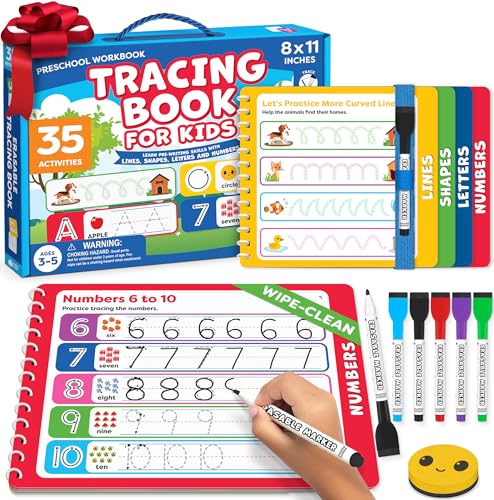
Designed to build confidence through hands-on learning, this dry-erase workbook set supports independent play and device-free creativity. The package includes six colorful markers, a smiley eraser, a pen holder, and a sturdy storage box for easy organization. Suitable for ages 3-5, it targets fine motor skill development and kindergarten readiness at home or in a classroom setting.
Key features include 35 toddler activities that introduce letter tracing, shapes, lines, and numbers 1-10. The activities help strengthen stroke recognition, color sorting, memory, and coordination—foundations critical for early writing. The materials are non-toxic and designed for repeated use with dry-erase pens and accessories, enhancing dexterity and focus.
Your Four-Year-Old: Wild and Wonderful

This book explores the early preschool years with an engaging narrative approach that resonates with children and parents alike. It presents a view of four-year-olds as capable, curious, and full of discoveries, supporting conversations about growth, relationships, and everyday learning moments. It offers a read-aloud option for caregivers seeking thoughtful, age-appropriate material.
School Zone Thinking Skills Workbook

Geared toward preschool and early kindergarten learners, this workbook emphasizes essential thinking skills, problem-solving, and logic. The exercises are designed to challenge young minds while remaining accessible, with a clear progression that supports confidence as children tackle puzzles and reasoning tasks. A practical resource for families and classroom use alike.
School Zone Connect the Dots Workbook

With 32 pages of dot-to-dots, counting, and coloring, this workbook aids number sense and sequencing for ages 3 to 5. The activities blend visual motor skills with early math concepts, supporting preparation for classroom routines and independent work. The clear layout helps maintain focus and engagement during daily practice sessions.
Buying Guide: Key Considerations For Choosing Early Learning Books
When selecting parenting books and activity workbooks for a four-year-old, consider how each title fits into daily routines, attention spans, and developmental goals. The following factors help compare options across reading, writing, and problem-solving skills:
- Learning objectives: Identify whether the book targets handwriting readiness, number sense, problem-solving, or a combination of skills.
- Format and durability: Dry-erase options enable repeated use, while traditional workbooks emphasize single-use practice. Consider the child’s tendency to focus and the home or classroom setting.
- Age appropriateness: Confirm the age range and level of challenge to ensure content matches the child’s current abilities without causing frustration.
- Engagement and form: Books that combine activities with playful visuals, color coding, and clear instructions tend to sustain interest longer.
- Parental involvement: Some titles are designed for guided activities while others promote independent exploration; align with your preferred home-learning style.
- Durability and materials: Non-toxic inks and sturdy pages are important for frequent use and for parents seeking long-lasting resources.
- Skill progression: Look for sequences that progressively build literacy and numeracy, and that allow stepping up to more challenging tasks over time.
In sum, these titles offer complementary approaches: writing readiness through tracing, cognitive development via thinking skills, and early numeracy through connect-the-dots and counting activities. Depending on the child’s interests and routine, a combination of these resources can provide a well-rounded early learning toolkit without screens.