Answering the question “which notebook is best for calculus?” this guide selects five graph-ruled or grid-focused notebooks that support graphing, problem-solving, and organized notes. Each choice suits students, engineers, or professionals who blend math with classroom or office work. The picks emphasize graph-friendly ruling, durability, and ease of use in binders or backpacks. Below is a quick comparison, followed by detailed product insights and a practical buying guide.
| Product | Why It Stands Out |
|---|---|
| Mead Graph Notebook, Green | Compact, graph-ruled, perforated sheets for quick handouts |
| Mead Graph Notebook, Black | Same graph ruling, ideal for color-coded notes in a binder |
| Five Star Graph Notebook | Ink-bleed resistant paper and reinforced storage pocket |
| Zaviko Graph Paper Pad | 8.5 x 11 grid with easy-tear top, suitable for large problems |
| Dilitego Hardcover 5 Subject | Multiple sections with removable dividers for subject organization |
| SUNEE Graph Notebook | 3-hole punched, affordable single-subject grid notebook |
Mead Spiral Notebook, Graph Ruled, Green
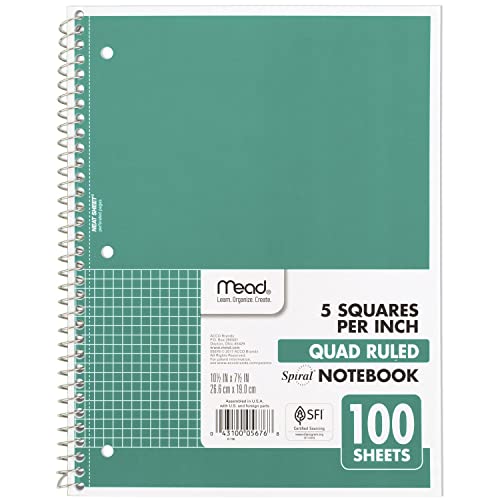
Best for students who want a compact, graph-ruled 1-subject notebook that’s easy to toss into a bag. This Mead 100-sheet notebook uses graph ruling with 5 squares per inch and perforated sheets for clean tearing. It is 3-hole punched, making it binder-friendly for coursework and lab notes. Best for quick graph plotting and organizing alternating problems on the same page. A potential limitation is the smaller size; it may require multiple notebooks for extensive calculus work.
Mead Spiral Notebook, Graph Ruled, Black

Best for right-handed writers who prefer a darker cover for durability and easy identification in a stack. Like the green version, this 100-sheet, 1-subject notebook uses 5-squares-per-inch graph ruling and perforated pages for clean removal. It’s 3-hole punched to fit standard binders, making it practical for ongoing coursework. Limitation: color differences may affect visibility of notes if you rely on high-contrast pages for grading notes.
Five Star Graph Notebook + Study App

Best for rigorous study routines. This 1-subject notebook offers 100 graph-ruled sheets at 4 squares per inch, with water-resistant cover and ink-bleed resistant paper. It includes a storage pocket for loose sheets and patented reinforced edges to prevent tearing. Choose this if you want reliable note preservation over a full term. Caution: slightly heavier due to reinforced features.
Zaviko Graph Paper Pad 8.5 x 11, 2 Pack

Best for larger problem sets and engineering-style sketches. The pair includes 30 sheets per pad with 4×4 grid, top perforations for easy removal, and 70 GSM paper designed to reduce bleed-through. It’s suitable for notes, algebra, geometry, and calculus, offering ample space for graphs. Limitation: not a single-subject notebook, so you may need to combine with additional organizational tools.
Dilitego Hardcover 5 Subject Notebook

Best for multi-subject planning. This 5-subject notebook features a leather hardcover, removable dividers with eight tabs, and 300 pages of 100 GSM ivory paper. It supports a structured approach to calculus topics across chapters, labs, and notes. The top-notch durability reduces wear in daily use. Limitation: larger size and heavier weight may reduce portability for quick notes between classes.
SUNEE Spiral Notebook, Graph Ruled

Best value option for single-subject needs. This SUNEE notebook offers 100 double-sided sheets, 3-hole punched, with graph ruling and a water-resistant cover. It’s suitable for students who want a straightforward, affordable graph notebook for calculus problem sets and plotting. Limitation: lighter cover may wear faster with heavy use in backpacks.
Buying Guide
- Graph ruling density: For calculus, 4 to 5 squares per inch is ideal for plotting graphs and sketching curves without crowding the page.
- Paper quality and bleed-through: Look for 70–100 GSM or higher to minimize ink bleed-through when using pencils, gels, or ink pens.
- Durability and binding: A sturdy cover (hardcover or reinforced) and a spiral or ring bound notebook helps keep pages flat during long problem-solving sessions.
- Organization features: Dividers, perforated pages, and pockets help separate topics like limits, derivatives, and integrals, making review easier.
- Binder compatibility: If you use a binder, choose 3-hole punched pages; if you need portability, consider perforated edges for quick removal.
- Size and portability: 7–8.5 inches by 9–11 inches suits most backpacks and laptop bags; larger pages suit extended problems but are less portable.
- Multi-subject options: For students juggling topics across courses, a 3–5 subject notebook can reduce bulk while keeping sections distinct.
Practical tips: If you frequently solve long calculus problems, prefer grid or quadrille paper (4×4 or 5×5) to maintain alignment. Use perforated sheets when you need to share or submit work. For course planning, a dedicated 5-subject notebook can help separate chapters and problem sets by topic.
FAQ
- What is the best graph ruling for calculus? A 4×4 or 5×5 grid is often ideal for plotting functions and drawing accurate graphs without crowding notes.
- Should I choose perforated or non-perforated pages? Perforated pages are convenient for sharing or submitting work, while non-perforated pages offer sturdier pages for long-term notes.
- Is a hardcover notebook better than a spiral for calculus? Hardcover notebooks provide durability and a flat writing surface when open, while spiral options are easier to lay flat on a desk.
- How many sheets do I need? For a semester-long calculus course, 100–300 sheets across one or multiple notebooks typically covers lecture notes and problem sets.
- What about binder compatibility? If you rely on a binder, ensure the notebook is 3-hole punched or has perforated pages you can easily remove and insert into the binder.
- Can multi-subject notebooks work for calculus? Yes, if you prefer organized sections by topic; however, separate graph-ruled notebooks can reduce distraction and keep graphs crisp.