Finding the right math aids for seventh graders can boost confidence and close gaps in foundational skills. Below are five carefully selected resources that combine practice, engagement, and clear explanations. Each item supports essential topics like fractions, algebra basics, number sense, and problem-solving strategies. The table summarizes key details to help you compare at a glance.
| Product | Brand | Subject Focus |
|---|---|---|
| Seventh-Grade Math Minutes: One Hundred Minutes to Better Basic Skills | Creative Teaching Press | Basic Math Skills, Fluency |
| Spectrum Grades 6-8 Algebra 1 Workbook | Carson Dellosa Education | Algebra, Fractions, Graphing |
| Numli – Math Booster Game 5th-7th Grade | Niche Nation Games | Number Sense, Mental Math |
| Carson Dellosa The 100 Series Algebra Workbook | Carson Dellosa Education | Fractions, Ratios, Algebraic Expressions |
Each product emphasizes active practice, quick feedback, and age-appropriate challenges. Explore real-world applications, classroom-ready activities, and engaging formats designed to sustain seventh-grade students’ math interest while building a strong skill foundation.
Seventh-Grade Math Minutes: One Hundred Minutes to Better Basic Skills

This resource uses the well-known Math Minutes format to reinforce core seventh-grade math skills. It presents 100 Minutes, each containing 10 problems to be completed in about one to two minutes. The short, timed activities promote rapid recall and fluency while keeping students engaged. Teachers can use the book as warm-up tasks, quick checks for understanding, or on independent work days. The concise structure supports routines and pacing in busy classrooms, homeschool settings, or tutoring sessions. The book’s classroom-tested approach aims to build automaticity in essential operations and early algebraic thinking.
Spectrum Grades 6-8 Algebra 1 Workbook
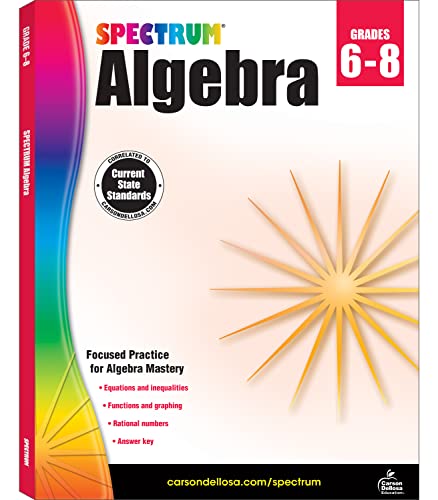
This workbook supports middle school learners with a strong emphasis on algebra basics and related topics. It functions as a practical supplement to daily lessons, featuring activities designed to reinforce factors, fractions, equalities and inequalities, functions, graphing, and proportions. Clear instructions guide students through problems, while progressively challenging activities aim to extend problem-solving and analytical abilities. Suitable for classroom use or homeschooling, the workbook aligns with common seventh-grade mathematics standards and provides a structured path to mastery of essential concepts.
Numli – Math Booster Game 5th–7th Grade

This classroom game emphasizes number sense and quick thinking through linked-number challenges. Players solve math problems while racing to uncover numerical connections, promoting mental math, estimation, and strategic thinking. It’s designed for indoor recess, group activities, or family math nights, encouraging collaboration and discussion around problem-solving approaches. The game format helps 7th graders practice arithmetic in a dynamic setting, offering a hands-on alternative to traditional flash cards and worksheets while reinforcing foundational skills in a competitive, engaging way.
Carson Dellosa The 100 Series Algebra Workbook

Designed for seventh grade and up, this algebra-focused workbook covers fractions, ratios, algebraic expressions, and related topics. With 128 pages of practice, it provides a structured sequence of problems and explanations to build procedural fluency and conceptual understanding. Teachers and tutors can use it to supplement lessons, assign targeted practice for home study, or monitor growth through regular review. The material emphasizes both solving and graphing equations, supporting a well-rounded approach to early algebra readiness.
Buying Guide for 7th Grade Math Tools
Choosing the right math aids requires balancing skill targets, learning styles, and classroom or home practice needs. Consider these purchase factors to align resources with seventh-grade standards and goals:
- Grade alignment and scope: Select tools that explicitly address fractions, decimals, percentages, basic algebra, and graphing—core areas for seventh graders. Confirm that activities scale from simple to more complex problems to match skill progress.
- Format and pace: Timed practice can boost fluency but may feel stressful for some students. Look for a mix of quick drills and longer, explanatory sections to accommodate different working speeds and attention spans.
- Active learning versus passive review: Card games, manipulatives, and short interactive tasks promote engagement more than repetitive worksheets. Prioritize resources that require students to explain their reasoning or estimate answers.
- Teacher and tutor fit: Consider whether a resource is classroom-ready, homeschool-friendly, or suited for one-on-one tutoring. Materials with clear teacher guides, answer keys, and progress checks help monitor growth.
- Durability and format: Physical books and durable card games work well for frequent use. If you prefer digital options, ensure compatibility with devices and platforms and assess whether online components add value without increasing cognitive load.
- Assessment and tracking: Materials with built-in review sections or progress indicators support ongoing assessment. This helps identify persistent gaps and tailor subsequent practice.
- Cost and value: Weigh the breadth of content against the price. A comprehensive algebra workbook might offer long-term utility, while targeted games can provide high engagement for short-term rotations.
- Inclusivity and accessibility: Ensure topics are explained clearly for diverse learners. Look for resources with visual aids, step-by-step instructions, and examples that connect math to real-life situations.
These considerations help ensure the chosen tools support steady skill development, foster mathematical thinking, and align with the learner’s pace and motivation. When combined thoughtfully, the selected products can create a balanced learning toolkit that complements classroom instruction and homeschooling efforts alike.