Finding the right math books for beginners helps young learners build foundational skills with engaging activities and real-world contexts. This guide highlights five beginner-friendly options that cover basic addition, subtraction, number sense, and early algebra concepts. Each pick focuses on practical practice, clear instruction, and age-appropriate challenges to support steady progress for kids just starting their math journeys.
The following summary table helps compare the selected products at a glance, including target age or grade, focus area, and key features. Use this as a quick reference to decide which title aligns best with a student’s current math goals.
| Product | Brand | Focus | Key Features | Typical Use |
|---|---|---|---|---|
| School Zone Addition & Subtraction Workbook | School Zone | Addition, Subtraction, Place Value | Sums, differences, place value, regrouping, fact tables, 64 pages | Early elementary practice for 1st–2nd grade |
| Remedia Publications REM109A Market Math for Beginners | REMEDIA PUBLICATIONS | Real-life math, shopping scenarios | Develops math reasoning and computation through shopping contexts | Grade 3–6 foundational skills in a practical setting |
| Math Curse | Viking Books for Young Readers | Creative math thinking | Humorous, engaging look at math’s breadth for ages 6+ | Encourages curiosity and flexible problem solving |
| Spectrum Algebra Practice | Carson Dellosa Education | Algebra basics, sequences, graphs | Strengthens algebra readiness with easy-to-follow activities | Classroom or homeschool supplement for 11–14 |
The table above previews how each book approaches early mathematics—from straightforward number facts to real-world reasoning and introductory algebra. The following sections provide detailed, objective descriptions of each title, highlighting features that commonly help beginners build confidence and long-term math skills.
School Zone Addition & Subtraction Workbook

The School Zone workbook emphasizes foundational arithmetic with a focus on addition and subtraction concepts suitable for ages 6–8. It includes practice on place value, regrouping, and number sense, organizing activities in a 64-page format designed to engage early learners with varied task types. The workbook’s structured layout supports repeated practice and can complement classroom lessons or homeschooling routines. Clear prompts and progression help track skill development over time.
Remedia Market Math For Beginners

Remedia’s Market Math for Beginners uses real-life shopping scenarios to sharpen math reasoning and computation. Geared toward grades 3–6, the material offers a practical context that helps students apply basic arithmetic to everyday situations. The book’s approach blends fun activities with foundational skills, supporting students who benefit from concrete, applied math experiences. It is a strong choice for learners who respond to real-world relevance and visual prompts while building confidence in calculation accuracy.
Math Curse

Math Curse introduces broad mathematical thinking through playful storytelling and humor. While suitable for ages 6 and up, the book encourages readers of all levels to see math in everyday life, fostering curiosity and flexible problem solving. It serves as a gentle bridge from basic arithmetic to more expansive math ideas, helping students appreciate the relevance and joy of mathematical thinking beyond routine exercises. The narrative approach complements more technique-focused work.
Spectrum Algebra Practice
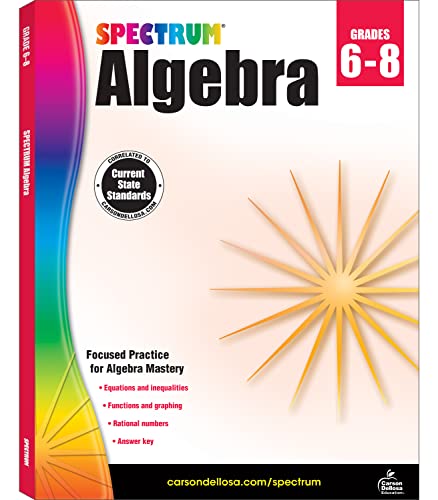
Spectrum Algebra Practice provides a structured path to algebra readiness with emphasis on factors, fractions, equalities, inequalities, and graphing. While it targets early middle school learners, the activities are accessible for motivated beginners and as a continual practice resource for classroom or homeschool use. Clear instructions and progressive challenges help students build problem-solving and analytical thinking skills essential for algebraic reasoning.
Buying Guide
When selecting math books for beginners, consider these purchase factors to align with a learner’s needs and long-term goals:
- Age and grade alignment: Choose titles that match current skill levels while offering gentle progression to more advanced topics.
- Instructional style: Some books favor routine practice and drill, others emphasize real-world applications or storytelling. A mix can support broader engagement.
- Skill scope: Ensure coverage includes number sense, basic operations, and if desired, introductory algebra concepts to prepare for later grades.
- Practice variety: Look for a blend of problems, word problems, visual models, and exercises that accommodate different learning preferences.
- Durability and format: For worksheets, consider page count and binding; for books, look at print quality and readability.
- Supplemental materials: Some books include answer keys, explorations, or teacher guides. Decide if you want additional guidance for parents or educators.
- Educational approach: Real-life context can improve transfer of skills to everyday math, while abstract drills strengthen accuracy and speed. A balance is often best.
- Progress tracking: Books that offer progression clues or clear skill milestones help monitor improvement over time.
Overall, beginner math books should provide clear explanations, attainable challenges, and opportunities to apply new skills. The selected titles offer a spectrum of approaches—from direct practice in foundational operations to engaging narratives and real-world scenarios—allowing families and classrooms to tailor instruction to each learner.