Finding the right handwriting materials for first graders helps build confidence and accuracy in letter formation, spacing, and writing readiness. The following five books balance guided practice with age-appropriate activities, supporting both classroom learning and at-home tutoring. Each selection emphasizes legible handwriting, consistent letter placement, and engaging exercises that align with early elementary standards.
| Product | Brand |
|---|---|
| Learning Without Tears My Printing Book Student Workbook | Learning Without Tears |
| Mead Primary Composition Book | Mead |
| School Zone Addition & Subtraction Workbook | School Zone |
| School Zone Big First Grade Workbook | School Zone |
| Evan-Moor Daily Handwriting Practice Traditional Manuscript | Evan-Moor Educational Publishers |
Learning Without Tears My Printing Book Student Workbook

The Learning Without Tears workbook expands writing space and introduces digital instruction opportunities. It emphasizes correct use of lowercase letters within words and sentences, supporting early learners in forming consistent letter shapes and spacing. The guided layout aligns with handwriting standards for first graders, providing a structured path from tracing to independent writing. This resource can be used in school or home settings to complement daily handwriting practice and reduce frustration during skill development.
Mead Primary Composition Book
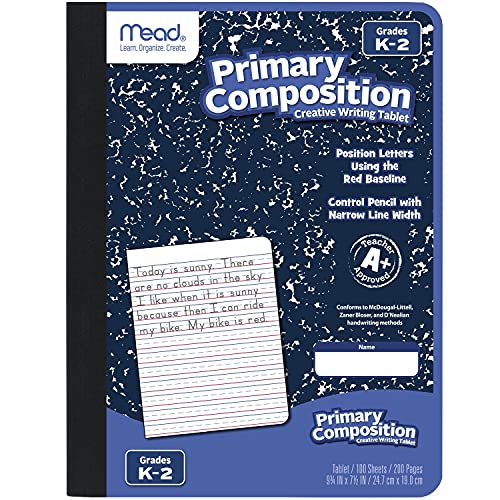
This primary ruled composition book is designed for grades K-2 with 100 double-sided sheets featuring solid and dotted lines. The layout supports early handwriting practice, letter sizing, and line placement, helping students build consistent handwriting habits in a format conducive to daily journaling, spelling practice, and quick handwriting checks. Its durable construction makes it suitable for classroom use and at-home homework.
School Zone Addition & Subtraction Workbook

While primarily a math workbook, this resource offers a structured format that can reinforce daily practice and sequencing, which complements handwriting by fostering attention to detail, pattern recognition, and focused work sessions. It includes 64 pages of varied activities suitable for first and second graders, promoting consistency in task completion that can parallel handwriting routines.
School Zone Big First Grade Workbook

This 320-page workbook covers a broad first-grade curriculum, including phonics, reading, math basics, time, money, fractions, and story problems. Its color-coded sections and clear, easy-to-follow lessons help students build foundational literacy and numeracy while reinforcing attention to detail, a skill closely tied to neat handwriting. The extensive pages provide ample practice opportunities for consistent letter formation in longer writing tasks.
Evan-Moor Daily Handwriting Practice Traditional Manuscript

Evan-Moor’s Daily Handwriting Practice offers traditional manuscript activities for a range of grades, including Kindergarten through Grade 6. The workbook focuses on penmanship fundamentals such as letter placement, spacing, and consistent size. It serves as a practical routine for daily handwriting work, providing a structured, classroom-ready resource that supports teachers and homeschooling families in sustaining regular handwriting practice across weeks and months.
Buying Guide: Key Handwriting Book Considerations
Selecting the right handwriting book for a 1st grader involves evaluating purpose, structure, and student needs. Consider these factors to compare options effectively:
- Learning approach: Tracing-first, then independent writing, or a mix of both. Choose materials that gradually increase writing independence.
- Letter formation emphasis: Look for guides that stress correct letter shapes, direction, and slope, and include lowercase emphasis, which is common in early literacy.
- Practice space and pacing: Books with ample writing space and clear progression help prevent fatigue and encourage steady practice.
- Reinforcement through additional activities: Some titles pair handwriting with phonics, reading, or math to integrate skills; this can be beneficial for multi-skill development.
- Durability and usability: For home use, consider binding, page quality, and whether the book is designed for reuse or single-use practice.
- Digital integration: If digital lessons are offered, assess how well they complement physical pages and whether they align with classroom instruction.
- Age appropriateness: Ensure the reading level and activity complexity match a typical 1st-grade student’s capabilities.
- Teacher and caregiver resources: Some books include teacher pages, rubrics, or answer keys to guide tutoring sessions.
When choosing, balance a book that provides clear instruction with enough practice opportunities. It can be advantageous to select one foundational handwriting text for daily use and pair it with a supplementary workbook that supports broader academic skills—such as early math or reading—without overwhelming the learner.