For nursing students, concise, high-yield flashcards can streamline study sessions and reinforce key concepts across pharmacology, terminology, anatomy, and exam review. This guide highlights five carefully chosen flashcard sets that align with common nursing curricula and NCLEX ATI HESI benchmarks. Each selection emphasizes essential information, durability, and portability to support efficient, focused revision.
| Product | Brand | Core Focus |
|---|---|---|
| Pharmacology Flash Cards – No Fluff | Level Up RN | Pharmacology essentials for nursing exams |
| Top 300 Drugs Flashcards | gisgfim | Drug names, interactions, dosages |
| 500 Double-Sided Terminology Flashcards | Tribe RN | Medical terminology and related topics |
| Nursing Fundamentals Flash Cards | Level Up RN | Fundamentals, practice topics, ATI/HESI readiness |
| Nursing Mnemonics Flashcards | Nurse Readiness Academy | Mnemonic-based memory aids for concepts |
Pharmacology Flash Cards – No Fluff

Level Up RN’s Pharmacology Flash Cards focus on core NCLEX pharmacology content essential for nursing exams. Cards emphasize essential pharmacokinetics, prescription information, food-drug interactions, antidotes, and medications by body system. The set is designed for nursing school students seeking targeted, exam-tested content. It’s recommended for nursing students and is less suitable for pre-nursing or medical assistants. This deck provides a compact, focused study tool ideal for quick reviews and on-the-go study sessions.
Top 300 Drugs Flashcards
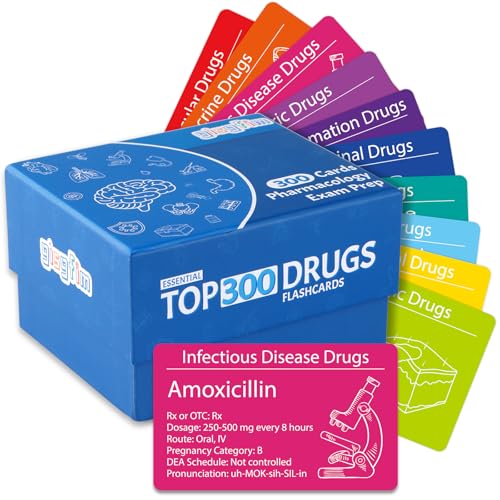
gisgfim offers a comprehensive set with 300 pharmacology flash cards covering the most commonly used drugs. The format is compact and portable, enabling quick, anywhere study sessions. Cards are designed to help you master drug information swiftly, supporting success in nursing, pharmacy, and medical exams. Built for durability, these cards withstand repeated handling during intensive review periods.
500 Double-Sided Terminology Flashcards

Tribe RN’s Terminology flashcards deliver 500 double-sided cards with color-coded organization. They cover medical terminology, pharmacology, and med-surg topics, making complex terms easier to memorize. The set includes a 1.5-inch sorting ring and a sturdy storage box. Bonus sorting cards like “Work in Progress” and “Mastered It!” help structure study sessions and track progress.
Nursing Fundamentals Flash Cards

Level Up RN’s Fundamentals Flash Cards distill essential topics for nursing fundamentals, including principles, practice and skills, gerontology, leadership, and community health. The deck is especially useful for LPNs, RNs, and PCAs preparing for fundamentals coursework and related exams. It emphasizes exam-tested content while noting it may not be ideal for those not yet in nursing school.
Nursing Mnemonics Flashcards

Nurse Readiness Academy’s Mnemonics Flashcards use illustrated, mnemonic-rich cards to simplify complex clinical concepts. These flashcards aim to build confidence, enable rapid recall, and support memorization through proven mnemonic techniques. They’re designed to help nursing students participate more actively in clinical discussions and care planning.
Buying Guide
Key purchase considerations for nursing flashcards include:
- Content scope: Choose decks that align with your current course focus—pharmacology, terminology, fundamentals, or anatomy—so you don’t waste study time on non-tested material.
- Card durability and format: Durable materials, clear printing, and a portable size (3×5 inches or similar) support long-term use and easy transport between classes.
- Organization and memory aids: Color coding, sorting rings, and mnemonic devices can improve recall and help structure study sessions.
- Exam alignment: Prioritize sets that emphasize NCLEX, ATI, or HESI-style questions and content frequently tested in nursing programs.
- Supplemental resources: Some decks offer digital memberships or bonus resources; weigh whether these additions justify the extra investment.
In-depth evaluation should consider how a deck integrates with your study routine: quick reviews between lectures, structured practice sessions, and targeted drills for weak areas. Cross-referencing multiple decks can fill content gaps, but ensure you don’t duplicate information excessively, which can slow progress. For best results, pair flashcards with active practice questions and periodic self-assessments to monitor knowledge growth over time.