Finding the right educational books for young learners can boost early literacy, critical thinking, and a lifelong love of learning. The following selections are chosen for their clear activities, age-appropriate challenges, and engaging formats that keep kids motivated. Each title blends skill-building with enjoyable interaction, whether at home or in early education settings.
Summary of featured products:
| Product | Brand | Focus | Edition |
|---|---|---|---|
| Preschool Learning Activities | Momo & Nashi | Letter tracing, shapes, numbers | 3-5 years |
| School Zone Thinking Skills Workbook | School Zone | Problem-solving, logic & reasoning | 3-5 years |
| School Zone Connect the Dots Workbook | School Zone | Dot-to-dots, counting, number puzzles | 3-5 years |
| 100 Words Kids Need to Read by 1st Grade | Scholastic | Sight word practice, reading readiness | 1st grade readiness |
| Additional Resources | Various | Reading foundations and early literacy | Early learners |
Preschool Learning Activities: Tracing and Early Skills Kit
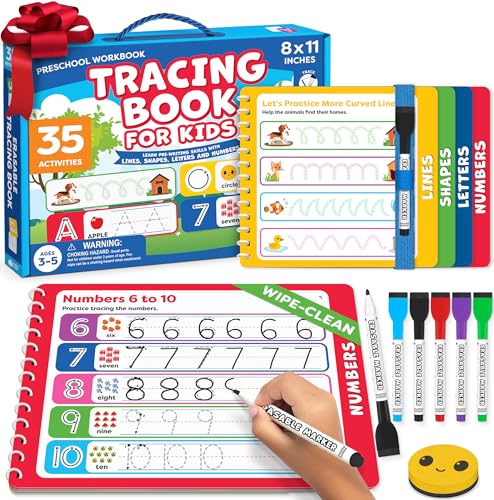
The Preschool Learning Activities set by Momo & Nashi combines tracing practice with hands-on exploration designed for ages 3-5. The kit includes six colorful markers, a smiley eraser, a pen holder, and a sturdy storage box—offering a device-free way to build fine motor skills and early writing confidence. The dry-erase format supports repetitive practice, helping children refine strokes and form while staying engaged through repeated attempts. Ideal for homeschooling, daycare centers, or Montessori-inspired spaces seeking structured, independent activities.
Key features at a glance include: dry-erase usability, portability with storage, and a focus on handwriting readiness as part of a holistic early education approach. The activities promote letter tracing, shape and number recognition, color sorting, and memory games that support attention span growth. Suitable for 3- to 4-year-olds, this kit also serves as a meaningful gift for young learners and their families.
Considerations: Dry-erase durability matters for long-term use, and supervision may help younger children maximize the tracing benefits. The kit emphasizes fine motor development as a foundation for writing, which can complement phonics and reading programs in early education settings.
School Zone Thinking Skills Workbook: 64 Pages

This Thinking Skills Workbook from School Zone is designed to develop problem-solving, logic, and reasoning abilities in preschool and kindergarten learners. With 64 pages of activities, it blends age-appropriate challenges that encourage critical thinking alongside engaging visuals. The workbook aligns with early learning standards by reinforcing patterns, sequencing, and spatial reasoning through approachable puzzles and guided exercises.
Highlights include structured activities that progress in complexity, enabling teachers and parents to monitor growth over time. The workbook supports independent work and can be integrated into daily routines, making it a practical addition to early literacy and numeracy programs. It works well for brief daily sessions and as a supplement alongside phonics and math practice.
Considerations: Some users may prefer more explicit instructions or answer keys for quick feedback. It pairs well with other foundational workbooks but can be used standalone for short learning blocks. Durability and spiral-bound formats can influence usability in busy classrooms or at home.
School Zone Connect the Dots Workbook: 32 Pages

The Connect the Dots Workbook from School Zone offers a focused set of activities for ages 3 to 5, emphasizing dot-to-dots, counting, and basic number puzzles. With 32 pages of coloring and numeracy exercises, this workbook provides a gentle progression from tracing to counting readiness, helping children develop visual-motor coordination and early math instincts. It complements handwriting practice by reinforcing number sequences and fine motor control.
Key benefits include its straightforward layout, kid-friendly illustrations, and print-ready pages that encourage repetition and mastery. Teachers and parents can use it to structure short, daily tasks, track progress, and celebrate small wins. The content aligns well with early literacy goals by embedding counting within a broader exploration of shapes and numbers.
Considerations: As with similar products, some children may need additional support with pencil grip and steady hand movements. Integrating this workbook with broader literacy activities can maximize learning outcomes, especially in the transition to early math concepts.
100 Words Kids Need to Read by 1st Grade

The Scholastic title 100 Words Kids Need to Read focuses on essential sight words necessary for early readers. By reinforcing the most frequently used words, the book supports smooth decoding, fluent reading, and comprehension. The workbook-like format includes fill-in-the-blank stories, sentences, word riddles, games, and puzzles that engage children while embedding high-frequency words in meaningful contexts.
Benefits include a structured progression that helps kids move from recognition to usage in writing and reading. It also provides a practical bridge from basic phonics to more complex literacy tasks, supporting classroom and home-based learning. The emphasis on repetition and context helps solidify word retention and reading speed as children approach first-grade material.
Considerations: Some learners may benefit from additional pronunciation guidance or audio supports to reinforce word familiarity. Pairing with guided reading activities can deepen mastery and ensure transfer to independent reading tasks.
Buying Guide: How to Choose the Right Early Education Books
Age and Skill Alignment
Choose titles that match the child’s current stage—tracing and fine motor activities for ages 3-4, and more complex word and logic tasks for ages 4-5. Look for books that clearly indicate the target age range and skill focus (letter formation, number sense, sight words, etc.).
Learning Style and Format
Consider whether the child benefits from dry-erase practice, workbook-style exercises, or dot-to-dot and coloring activities. A mix of formats can sustain engagement while addressing different cognitive skills—fine motor control, visual processing, and memory.
Durability and Reusability
Dry-erase and laminated components support repeated use, which is often cost-effective and ideal for classrooms or homeschool setups. Durable binding and clear, high-contrast illustrations help maintain attention during practice sessions.
Teacher and Parent Support
Look for resources that include simple instructions, answer keys, or teacher guides to facilitate feedback. Books that enable independent work can free up time for focused reading instruction, while guided activities can deepen comprehension and word recognition.
Integration With Core Skills
Choose titles that align with reading readiness, phonics, and early math concepts. A balanced selection that includes sight words, tracing, and problem-solving supports well-rounded literacy development and smooth transitions to first grade.
Accessibility and Inclusion
Consider inclusive designs that accommodate diverse learners, including options for different handwriting styles, ADHD-friendly layouts, and high-contrast visuals. Materials that offer variations or extensions help differentiate instruction for mixed-age groups.
Usage Scenarios
In homes, these books can structure short, daily practice sessions. In classrooms or daycares, they can anchor a daily literacy block or literacy centers, with teachers providing guided instruction and independent practice during centers or station rotations.
The selections above provide a spectrum of early education resources aimed at fostering handwriting readiness, logical thinking, counting basics, and sight word recognition. When choosing, consider the child’s pace, preferences, and the learning objectives you want to reinforce over the coming months.