For American families and classrooms focusing on early literacy, decodable readers support explicit phonics practice and steady progression. The following picks emphasize phonemic awareness, structured decodables, and engaging visuals that help students apply skills without guessing. This guide highlights five targeted options and offers practical buying considerations to help educators and parents choose the right fit for beginner readers.
| Product | Brand | Key Focus | Best For |
|---|---|---|---|
| hand2mind Guided Phonics + Beyond Decodable Books Unit 2 | hand2mind | Phonics readers, decodable stories, no irregular words | Kindergarten to early-grade classrooms |
| Bob Books – Set 1: Beginning Readers Box Set | Scholastic | Easy-to-read decodables, starter level | Young beginners, home or classroom |
| hand2mind Guided Phonics + Beyond Decodable Books Unit 4 | hand2mind | Phonics readers, decodables, explicit word teaching | Preschool to early elementary |
| hand2mind Guided Phonics + Beyond Decodable Books Unit 3 | hand2mind | Structured phonics progression, decodable texts | Kindergarten to first grade |
| Junior Learning Decodable Readers The Pods – Phase 2 | Junior Learning | First 21 letter sounds, science-of-reading approach | Ages 5+, Grade K |
The table above summarizes the five most relevant decodable options for beginning readers, focusing on systematic phonics, decodable passages, and supportive visuals. Each selection is designed to reduce guessing and build confidence through controlled vocabulary and predictable text structures. The following sections detail each product with a concise overview and practical usage notes.
Hand2mind Unit 2 Decodable Readers

These decodable readers are designed to engage students in reading while practicing focused phonics skills. The set includes ten fiction and ten nonfiction stories, encouraging learners to apply phonics before relying on pictures for comprehension. A key feature is the lack of irregular high-frequency words until explicitly taught, supporting a clear, structured progression.
Bob Books Set 1: Beginning Readers

Bob Books Set 1 offers genuine beginner-friendly text with simple, consistent phonics patterns. The packaging is straightforward, and the text is crafted for early readers to decode with growing independence. These books are commonly used for at-home practice or small-group instruction, supporting steady progress in early reading skills.
Hand2mind Unit 4 Decodable Readers

Unit 4 continues the Guided Phonics sequence with additional decodable titles. The materials emphasize word-level skills and decoding practice, paired with supportive visuals to scaffold comprehension after decoding. The Focus Lessons align with phonemic awareness activities to prevent reliance on memorized sight words too early.
Hand2mind Unit 3 Decodable Readers

Unit 3 provides a deliberate progression through decodable texts, with ten fiction and ten nonfiction pieces that prompt readers to apply phonics skills before pictures. The series emphasizes practical reading strategies and phonemic awareness as foundational to comprehension.
Junior Learning Pods Phase 2

The Pods Phase 2 focuses on the first 21 letter sounds with a structured progression and interactive features. It aligns with the Science of Reading framework and provides a 12-book package with bright illustrations to support engagement and decoding practice, suitable for early learners or guided reading groups.
Newmark Decodable Readers Set

This decodable book set focuses on short vowels, consonant blends, and digraphs, offering accessible practice for early readers. It emphasizes both decoding fluency and word-meaning connections, making it a versatile tool for home and classroom use. The set presents a manageable volume of titles for steady progress.
Junior Learning Pods Phase 3
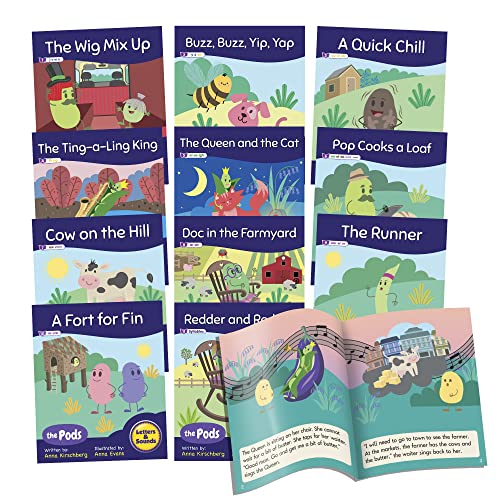
Phase 3 expands the decodable set with additional phonics coverage, continuing the science-based approach. The material includes 12 fiction books and a clearly defined progression, supporting students as they advance from early to more complex decodable text.
Buying Guide
Key considerations when selecting decodable books for beginning readers include cognitive load, phonics scope, and instructional alignment. Look for sequences that:
- Progress from simple to more complex sounds with clear decoding patterns.
- Limit irregular or high-frequency words until students have had explicit instruction.
- Offer a mix of fiction and nonfiction to build engagement and content knowledge.
- Provide teacher-focused supports, such as guiding notes or focus lessons, to ensure consistent phonic instruction.
- Include visuals that aid comprehension after decoding, not as a crutch for reading the text.
Consider the classroom context: whole-class rotation, small guided groups, or at-home practice. For mixed levels, a kit with multiple decodable levels can support differentiated instruction. Evaluate the length and variety of titles per unit to ensure enough practice without overstretching learners. Finally, assess alignment with the Science of Reading principles used in many contemporary curricula to ensure a cohesive approach across reading instruction.