Choosing the right composition notebook helps kindergarteners practice handwriting, draw freely, and build early literacy skills. The following five products are popular choices for K-2 classrooms and home learning, offering durable covers, kid-friendly layouts, and generous writing and drawing space. Use this guide to compare features, and find notebooks that support both writing practice and creative expression.
| Product | Brand | Pages / Sheets | |
|---|---|---|---|
| Mead Primary Composition Book | Mead | 100 sheets (200 pages) | Primary ruled with solid and dotted lines |
| Oxford Primary Composition Notebooks | Oxford | 100 sheets / 200 pages | Blue top line with dotted midline; includes alphabet guidance |
| Mintra Primary Composition Notebook (4 Pack) | Mintra Office | 80 sheets each | Flexible hardcover; drawing area included |
| Rosmonde 5 Pack Primary Composition Notebooks | Rosmonde | 100 sheets per notebook | Top drawing area; 100% primary ruled |
| Principal Lines 24 Pack | Principal Lines | 100 sheets per notebook | Draw and write layout; planet-themed cover |
Mead Primary Composition Book, Blue Marble
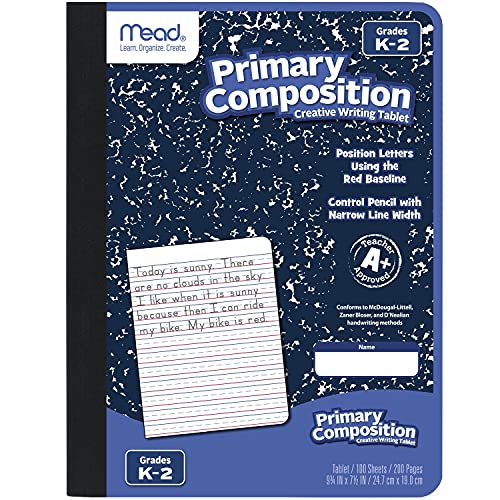
The Mead Primary Composition Book is designed for grades K-2, featuring 100 double-sided pages with 7-1/2″ x 9-3/4″ sheet size. The primary ruling combines solid lines with a dotted midline to guide early handwriting, while the durable cover supports daily classroom use. This notebook balances writing practice and drawing opportunities, making it suitable for combined literacy and creative sessions.
Oxford Primary Composition Notebooks with Animal Covers

Oxford’s 4-pack primary notebooks are intended for Pre-K through K-2, offering 100 sheets (200 pages) and a dedicated space for drawing on each page. The blue top line, blue dotted midline, and red baseline support legible handwriting, while the included alphabet chart on the front—plus a quick back-cover guide—helps kids form letters correctly. This set emphasizes handwriting development alongside creative expression.
Mintra Primary Composition Notebook (4 Pack)

Mintra offers a budget-friendly 4-pack with 80 sheets per notebook, sized 7.5″ x 9.75″ and a flexible hardcover for classroom durability. Each notebook includes a drawing area in addition to writing space, making it ideal for early learners who benefit from alternating between drawing and writing. The assortment supports both school and home use with a practical, kid-friendly design.
Rosmonde 5 Pack Primary Composition Notebooks

The Rosmonde five-pack features 200 pages per notebook (100 sheets), with thicker paper designed to handle pencils and crayons without excessive bleed-through. The dual-purpose pages offer a drawing area at the top and primary-ruled lines below, supporting storytelling and handwriting in one place. The compact 9-3/4″ x 7-1/2″ size is easy for young children to manage in class routines and on-the-go learning.
Principal Lines 24 Pack Primary Notebooks

Principal Lines offers a bulk option: 24 packs of 100 sheets each in a 9.75″ x 7.5″ format. The interior layout includes a half-page drawing area and seven main writing lines on the bottom, along with standard uppercase letters and numbers on the inside cover. The planet-themed cover adds a friendly, engaging vibe for young learners while maintaining robust paper quality for daily practice.
Buying Guide: Key Considerations For Kindergarten Notebooks
- Paper quality and ruling: Look for notebooks with primary or dotted midlines to support letter formation, plus thicker paper to minimize bleed-through when using pencils or crayons.
- Drawing space: A half-page top area for drawing helps children illustrate ideas before writing, reinforcing storytelling skills and imagination.
- Durability: Flexible or sewn bindings and sturdy covers withstand frequent handling by active learners, both at home and in classrooms.
- Size and portability: Narrow or compact sizes (around 9.75″ x 7.5″) are easier for small hands to manage and fit into backpacks or desks.
- Layout variety: Some notebooks pair writing lines with drawing sections, while others are strictly lined; choose based on your child’s or classroom’s practice routine.
- Cost and value: Multi-pack options offer savings for teachers and families stocking multiple students, with attention to durability and paper quality.
- Educational features: Cover designs, inclusion of alphabet guides, and visual cues can enhance early literacy and letter formation without overloading pages.
When evaluating options, consider how the notebook will fit into daily activities—journaling, handwriting drills, drawing stories, or a combination of tasks. For classrooms, durability and cost per notebook are important, while at home, the emphasis might be on encouraging creativity alongside writing practice. Each of the five products listed above provides a different balance of these elements, so selecting a notebook that aligns with teaching goals or learning preferences is key.