Selecting the right calculator is essential for civil engineering work, from core calculations to complex data analysis. The following five models balance advanced functions, readability, and reliability, helping you tackle math, physics, and engineering problems with confidence. Each entry highlights key features to compare at a glance.
| Product | Brand | Key Benefit |
|---|---|---|
| Casio fx-115ES Plus 2nd Edition | Casio | Natural Textbook Display and 280+ functions |
| SPLAKS 991ES Ultra-Large Screen | SPLAKS | 417 functions with a 4-line display |
| NEWYES 991ES MAX | NEWYES | 417 functions, rechargeable with dual power |
| NEWYES 552 Functions Scientific Calculator | NEWYES | 552 functions plus writing tablet option |
| Sharp EL501X2BWH | Sharp | 10-digit display with extensive scientific functions |
Note: This selection emphasizes models suitable for civil engineering coursework and field calculations, prioritizing readability, range of functions, and durability.
Casio fx-115ES Plus 2nd Edition — Advanced Scientific Calculator

Casio’s fx-115ES Plus 2nd Edition combines a NATURAL TEXTBOOK DISPLAY℠ with over 280 functions, making it a versatile choice for civil engineering tasks. The natural display shows fractions, equations, and results as they appear in textbooks, easing interpretation during complex calculations. It performs advanced operations such as complex numbers, linear regression, summation, integration, permutations and combinations, and matrix/vector calculations. The 16-digit, 4-line LCD aids in multi-step problem solving, while its compact form supports portability between classroom and field sites.
SPLAKS 991ES Ultra-Large Screen Calculator
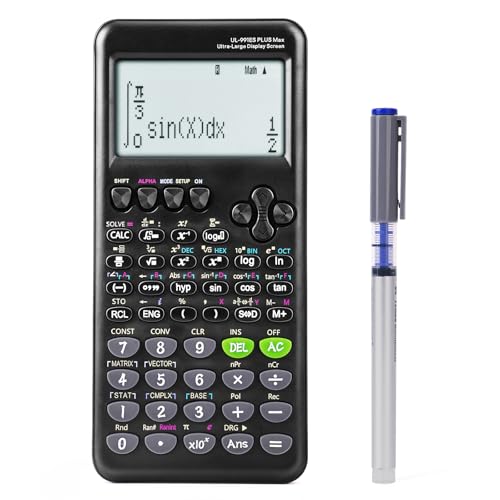
The SPLAKS 991ES offers 417 calculation functions, covering trigonometry, calculus, statistics, algebra, and more. Its ultra-large 4-line display supports clear reading, while the natural textbook display helps users interpret formulas and results quickly. An ergonomic, contoured body enhances comfort during extended use, and the durable anti-drop construction supports daily classroom or fieldwork demands. This model suits engineers who require extensive scientific capabilities in a single device.
NEWYES 991ES MAX — Rechargeable Scientific Calculator

The NEWYES 991ES MAX blends power with convenience, featuring 417 functions and a rechargeable design. The calculator supports complex number calculations, matrix operations, and linear regression, making it suitable for engineering analysis and coursework. With a four-line display, users can view input steps and results simultaneously, improving workflow. Dual power options (USB-C charging and solar) add reliability for long field sessions and classroom use alike.
NEWYES Scientific Calculator — 552 Functions

This model combines a scientific toolkit with a built-in writing tablet, enabling note-taking during calculations. With 552 functions, it handles fractions, statistics, complex numbers, linear regression, polar-rectangular conversions, and equations. The rechargeable design via USB-C supports sustained use, while the writing tablet feature helps engineers document derivations or intermediate results without leaving the calculator environment. It is well-suited for classroom labs and field projects requiring quick notation alongside computation.
Sharp EL501X2BWH Engineering / Scientific Calculator

The Sharp EL501X2BWH combines a 10-digit, one-line display with 146 essential scientific, mathematical, and statistics functions. It supports N-BASE calculations (OCT, BIN, DEC, HEX) and includes a dedicated memory. This makes it a practical option for civil engineering coursework and field calculations, offering straightforward operation and reliable performance for everyday engineering calculations and data analysis.
Buying Guide
Key purchase considerations for civil engineering needs include function breadth, readability, and durability. Users should evaluate:
- Display and readability: Look for Natural Textbook Display℠ or large multi-line screens to minimize interpretation errors during complex problems.
- Function set: Ensure the calculator supports calculus, statistics, matrix operations, trigonometry, and linear regression. For field use, durability (anti-drop, long battery life) matters.
- Power options: Solar or rechargeable with USB-C charging reduce battery anxiety on job sites or classrooms.
- Data recording: Writing pads or note-taking capabilities can help document derivations without switching apps or notebooks.
- Ergonomics: A comfortable grip and well-spaced keys improve efficiency during long calculation sessions.
- Budget and compatibility: Balance advanced features with cost and alignment to course requirements or employer standards.
In evaluating these models, consider your daily workflows: do you need extensive matrix and calculus support for structural analysis, or do you value a simple, reliable device for quick unit conversions and statistical checks? For many civil engineering students and professionals, a balance of readability, function breadth, and practical durability offers the best long-term value.