Geology opens a window to Earth’s history, rocks, minerals, and landscapes. This guide highlights beginner-friendly books and kits to build a solid foundation without needing advanced science background. Explore hands-on rock collections, introductory geology textbooks, field notebooks, and kid-friendly resources to foster curiosity and essential concepts in an accessible way.
| Product | Brand | Notes |
|---|---|---|
| DANCING BEAR 15 Pc Rock & Mineral Collection | DANCING BEAR | Beginner starter set with display box and educational material |
| Physical Geology | Prentice Hall | Standard introductory college-level text |
| The Unemployed Philosophers Guild Geology Field Notebook | The Unemployed Philosophers Guild | Portable field notebook for identifications and notes |
| Mark Twain Grades 5-8 General Science WorkBook | Mark Twain Media | Intro science basics including earth science topics |
| Evan-Moor The World: Reference Maps & Forms Book | Evan-Moor Educational Publishers | Maps, geography context useful for geological understanding |
DANCING BEAR 15 Pc Rock & Mineral Collection
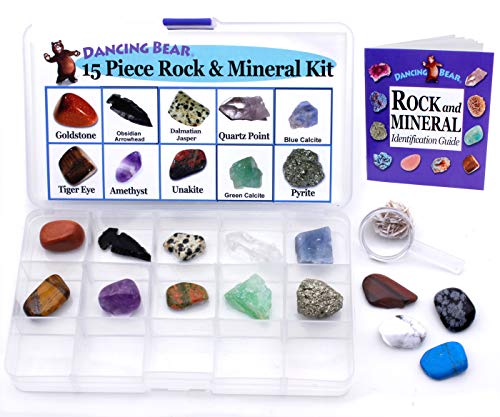
The Dancing Bear collection offers a 15-piece rock and mineral set arranged for beginners. It includes rough and tumbled specimens such as obsidian arrowhead, goldstone, quartz crystal point, amethyst, pyrite, and more, with an average stone size around 3/4 inch. A collector box and display case help keep rocks organized and portable. All stones are ethically sourced and hand-sorted to emphasize quality for educational exploration at home or classrooms.
Physical Geology

This Prentice Hall edition provides a comprehensive introduction to geology, covering rocks, minerals, plate tectonics, volcanism, and Earth processes. The text is designed for beginners and aligns with foundational concepts essential for further study in physical geology, mineralogy, and earth science programs. It emphasizes scientific thinking, diagrams, and real-world geology examples to help readers build solid foundational knowledge.
Geology Field Notebook

The Unemployed Philosophers Guild Geology Field Notebook is a compact, passport-sized journal tailored for field observations. It includes charts for rock identification, space for notes, and a compact format that fits easily in a pocket. This notebook supports beginners who want to document discoveries, track rock types, and reinforce learning through hands-on fieldwork without overwhelming complexity.
Mark Twain General Science WorkBook

This workbook introduces core science topics including earth science, weather, energy, and biology. It supports NSE standards and offers practice to reinforce understanding for students in grades 5-8. While broader than geology alone, the content provides essential context for beginners to connect geology concepts with broader scientific thinking and real-world applications.
The World: Reference Maps & Forms Book

This Evan-Moor resource focuses on introductions to continents, elevations, and country profiles, with teacher support pages and reproducible student pages. While primarily geography-oriented, its maps and spatial context complement geological learning by helping beginners interpret Earth’s surfaces, landforms, and geographic distribution of rocks and minerals.
Buying Guide
- Purpose and level: Choose materials that match your goals, whether hands-on exploration (rock kits), introductory theory (textbooks), or fieldwork notes (notebooks).
- Format and learning style: Visual learners may prefer image-rich textbooks and rock displays, while hands-on learners benefit from field notebooks and kits.
- Scope and sequence: For beginners, start with broad introductions to rocks, minerals, and Earth’s processes before advancing to more technical topics like mineralogy and geophysics.
- Durability and accessibility: Consider paperback vs. hardcover, page layout, and whether the material suits classroom, homeschool, or independent study.
- Supplemental resources: Combine a core geology text with practical tools such as a rock collection and field notebook to reinforce concepts.
- Safety and ethics: Ensure kits use ethically sourced specimens and provide guidelines for safe handling and disposal of materials.
- Future-proofing: Look for resources that align with standard curricula or widely accepted introductory frameworks to ease progression to advanced geology topics.
- Perspective coverage: Include both practical field tools and theoretical resources to address diverse learning preferences and add context with geography materials where helpful.