Expanding vocabulary is a cornerstone of clear communication, stronger reading comprehension, and more confident writing. This guide highlights five highly regarded books and workbooks designed to help readers from elementary through middle school strengthen their word knowledge. Each selection offers practical activities, engaging practice, and structured steps to learn new terms, roots, and usage in context. Explore options that fit independent study, homeschooling, or classroom use, and discover how consistent practice with these resources can elevate vocabulary skills over time.
The following table provides a quick snapshot of the chosen products, including their focus area and where to learn more online.
| Product | Brand | Link |
|---|---|---|
| Word Power Made Easy: The Complete Handbook for Building a Superior Vocabulary | Random House Group | Product Page |
| 240 Vocabulary Words Kids Need to Know, Grade 1 | Scholastic | Product Page |
| 240 Vocabulary Words Kids Need to Know, Grade 4 | Scholastic | Product Page |
| Evan-Moor Building Spelling Skills, Grade 4 | Evan-Moor Educational Publishers | Product Page |
| Spectrum Grade 4 Vocabulary Workbook | Spectrum | Product Page |
Word Power Made Easy: The Complete Handbook for Building a Superior Vocabulary

This classic vocabulary guide emphasizes practical word-building strategies, with clear explanations and actionable steps for expanding word knowledge. The book focuses on improving word choice, tone, and fluency, helping readers recognize and use more precise language in everyday reading and writing. Its approachable approach makes it suitable for self-directed study or guided classroom use, supporting long-term retention through structured practice and review.
240 Vocabulary Words Kids Need to Know, Grade 1

Designed for early learners, this Scholastic resource provides 24 ready-to-reproduce packets that make vocabulary practice engaging and manageable. Activities are research-based and structured to maintain student motivation, with clear context for each word to support understanding and retention. The program builds a foundation for reading comprehension by connecting new terms to prior knowledge in meaningful ways.
240 Vocabulary Words Kids Need to Know, Grade 4

For fourth-grade students, this resource expands on foundational vocabulary with more challenging words and activities. The ready-to-reproduce packets support classroom or homeschool settings, offering practice that reinforces word relationships, usage, and context. Lessons are designed to connect new terms with prior knowledge, promoting deeper understanding and confidence in applying vocabulary across reading and writing tasks.
Evan-Moor Building Spelling Skills, Grade 4

Although focused on spelling, this Evan-Moor workbook integrates spelling strategies with reading and writing skills. The resource provides reproducible worksheets that reinforce phonemic awareness, morphology, and word patterns. This makes it a practical complement for vocabulary-building efforts, helping learners recognize how spelling relates to meaning and usage.
Spectrum Grade 4 Vocabulary Workbook
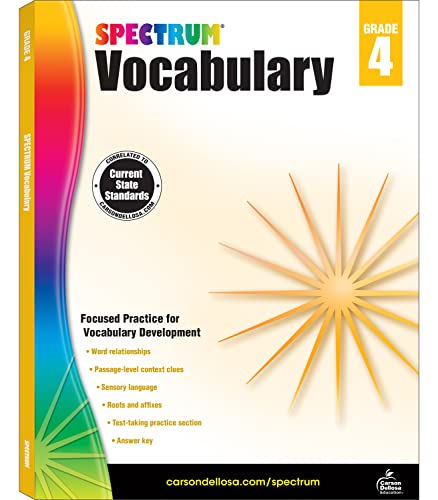
Spectrum’s Grade 4 Vocabulary Workbook emphasizes word relationships, context clues, roots and affixes, and sensory language. The focused practice supports both classroom learning and homeschooling, offering structured activities that reinforce vocabulary acquisition alongside reading comprehension. The workbook aligns with core language arts skills, helping students apply new words in context and improve word recognition.
Buying Guide: Key Purchase Considerations
- Learning level alignment: Match the book’s grade level and difficulty to the learner’s current vocabulary proficiency to maximize effectiveness.
- Practice structure: Consider whether you prefer reproducible packets, guided passages, or interactive exercises to sustain engagement and progress tracking.
- Contextual learning: Resources that emphasize word relationships, roots, and affixes help learners understand usage and etymology, improving retention.
- Supplementary materials: Look for companions such as teacher guides, answer keys, or digital components that support instruction and assessment.
- Accessibility: Choose formats (print, workbook, or homeschool-friendly layouts) that fit the learner’s study environment and routines.
- Application focus: Prioritize titles that offer context-rich examples, usage notes, and opportunities to practice vocabulary in writing and speaking contexts.
- Progress tracking: Some resources include quizzes or checklists to monitor growth, which can motivate continued study and provide clarity on next steps.
Across these selections, educators and individual learners can tailor a vocabulary-building plan that blends definition work with context, usage, and spelling. Selecting a mix of dictionary-style practice, word-family exploration, and meaningful reading can yield steady improvement and greater confidence in language mastery.