Whether you are just starting or expanding an existing operation, these practical books help you track finances, manage orders, and monitor inventory for import-export workflows. They are best for small business owners, freelancers, and new exporters who want clear record-keeping and actionable insights without complex software. This overview highlights five essential options and who each is best for, followed by a buying guide and answers to common questions.
| Product | Brand | Use Case |
|---|---|---|
| Income and Expense Log Book | Amoroud | Daily income/expense tracking and Profit & Loss clarity for small businesses |
| Sales Order Book (6 Pack) | Better Office Products | Two-part carbonless invoices and receipts for multiple orders |
| Inventory & Sales Log Book | Heveboik | Inventory, purchases, sales, and reorder tracking in one place |
| Adams Sales Order Book | Adams | Professional invoices with carbonless two-part forms |
The following sections detail each book, who it suits best, and practical considerations to help you choose.
Income And Expense Log Book For Small Businesses

This undated ledger is sized 8.5″ x 10.5″ with a durable polypropylene cover. Best for solo entrepreneurs or very small teams who need a clear, ongoing view of profitability. It includes two pages per week to log income and expenses, allowing quick daily or weekly profit/loss assessments. This book helps identify fluctuating expenses and supports basic profitability planning. A caution: it does not replace full accounting software for complex tax categories or multi-currency import-export scenarios.
Better Office Sales Order Book, 6 Pack 2-Part
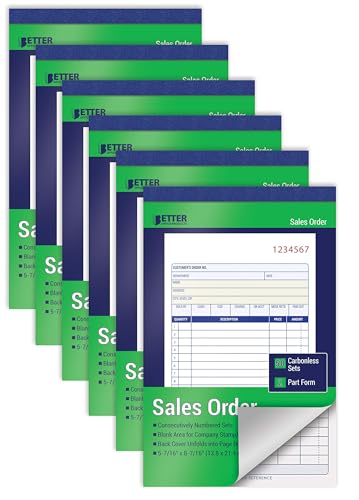
Best for teams handling multiple shipments or vendors, this six-pack provides carbonless two-part forms (customer copy and business copy) and consecutive numbering for easy tracking. The white top sheet captures the sale, while the canary bottom sheet records the details. Choose this if you need ready-to-file invoices on paper, with organized order sequences. Limitation: not a digital integration; inventory levels must be updated separately if you rely on real-time stock counts.
Inventory & Sales Log Book For Small Business

Designed to consolidate inventory tracking with sales and reorder management, this rose leaf-themed log book helps small businesses monitor stock, costs, and balances in one place. It is especially useful for online stores, consignment operations, or storefronts where quick access to data supports inventory decisions. Best for: buyers who want a single, easy-to-handle notebook for stock and sales. Caution: physical journal form may be less scalable for high-velocity, multi-warehouse environments.
Adams Sales Order Book, 2-Part Carbonless

Adams offers a compact and professional option for small businesses needing invoices that reflect a reliable image. The 2-part carbonless format ensures both client receipt and your records, with a wrap-around cover to keep sets neat. Best for service providers and small retailers who issue receipts on-site. Limitation: smaller page footprint may require more frequent reordering for high-volume operations.
Buying Guide
What should you consider when picking a record-keeping book for import-export activities?
What type of records are essential for import-export operations?
Key records include income and expenses, sales orders, inventory levels, purchases, and reorder points. A single book that tracks multiple aspects can reduce friction, but separate books may offer clearer focus for each process.
Should I choose carbonless forms or digital records?
Carbonless forms provide immediate receipts for clients and a persistent copy for your records without a printer. Digital solutions offer real-time syncing and reporting but require setup. For basic compliance and offline work, carbonless books are reliable.
How important is portability and size?
Smaller sizes are easier to carry on a ship or in a courier bag, while larger formats provide more space for notes. For field use in import-export workflows, a balance between readability and portability matters.
What if I scale up my business?
If volumes rise, plan for a transition to a dedicated accounting system or ERP. The books above work well at the start or for small teams, but integrating with inventory and financial software becomes important as complexity grows.
Are these books compatible with multi-currency or international deals?
These books focus on general business tracking and basic profitability. They do not inherently handle multi-currency accounting or exchange-rate tracking. For complex international trade, supplement with a software solution or add-on spreadsheets.
What is the best approach to data organization?
Use one book per major function (income/expenses, orders, inventory). Maintain consistent formats, dates, and references. Regular reconciliation with bank statements and supplier invoices improves accuracy.
FAQ
- Can these books replace a full accounting system? They provide core tracking for small operations but are not substitutes for comprehensive accounting software in growing businesses.
- Which book is best for new exporters? The Income and Expense Log Book helps establish profitability awareness early, while the Inventory & Sales Log Book supports stock control for import-export items.
- Are carbonless options necessary? Not required, but they simplify on-site invoicing and client receipts without a printer.
- How should I handle currency conversions? Use the books for base pricing and profits, but consider a separate tool or worksheet for currency conversion and exchange-rate tracking.
- Is a digital alternative better for international trade? Digital systems enable multi-user access and reporting, which can be advantageous for teams and remote suppliers.