Direct answer: For aspiring blues pianists, the following five books offer practical instruction, approachable arrangements, and timeless blues repertoire. Each selection targets a different skill level and playing style, from beginner-friendly layouts to advanced jazz-blues study. This guide helps you choose the right book based on your goals, whether you want online audio support, easy lyric-and-chord songs, or serious solo study.
Buyer snapshot: The top picks below are best for solo study, ensemble practice, and instructional progressions. The list includes beginner-friendly options, mid-level songbooks with classic blues standards, and advanced blues-jazz collections. Summary table of chosen products follows.
| Product | Best For | Key Feature |
|---|---|---|
| Blues Piano Complete Guide with Online Audio | Beginners to intermediate players seeking technique and theory | Online audio and thorough scale/soloing coverage |
| First 50 Blues Songs You Should Play on the Piano | Beginner to intermediate players who want familiar tunes | Easy arrangements with lyrics and chords |
| Jazz, Blues, Boogie and Swing for Piano Solo | Advanced students focusing on jazz standards and performance | 39 classic standards with full piano solo arrangements |
| Jazz, Rags & Blues Book 1 | Progressive learners exploring blues, jazz, ragtime | Format with book and online audio |
| John W. Schaum Piano Course: B — The Blue Book | Structured approach to fundamentals with color highlighting | Revised edition with new engravings and emphasis |
Blues Piano Complete Guide With Online Audio

Brand: Hal Leonard
Features: Book/Online Audio, Pages: 80, Instrumentation: Piano
Best for: Beginners to intermediate players who want structured blues technique, scales, chords, and soloing concepts with audio reference.
Why selected: Combines core blues piano fundamentals with guided practice, making it a solid foundation for building phrases, left-hand patterns, and improvisational concepts. The integrated online audio supports accurate rhythm and feel.
Caution: Shorter page count means topics are concise; may require supplementary material for in-depth theory.
First 50 Blues Songs You Should Play on the Piano
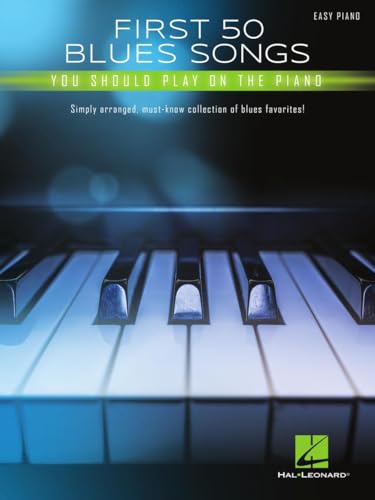
Brand: Hal Leonard
Features: Easy Piano, Pages: 186, Instrumentation: Piano/Keyboard
Best for: Beginners and early-intermediate players who want recognizable blues classics with simple arrangements and lyrics.
Why selected: A broad catalog of well-known tunes makes it easy to build a repertoire quickly, reinforcing chord shapes, right-hand melodies, and lyric interpretation.
Caution: Some songs may still require basic accompaniment skills; not all arrangements are strictly simplified for absolute beginners.
Jazz, Blues, Boogie and Swing for Piano Solo

Brand: Hal Leonard
Features: Contains 39 Classic Standards, Arranged For Piano Solo, Includes Lyrics
Best for: Intermediate to advanced players who want a compact solo library of jazz, blues, and boogie classics with lyric lines for interpretation.
Why selected: Highlights a stylistic bridge between blues and swing, encouraging expressive phrasing and rhythmic drive.
Caution: Some pieces may require solid reading skills and performance confidence due to full arrangements and occasional complex passages.
Jazz, Rags & Blues Book 1

Brand: Alfred Music
Features: Format: Book & Online Audio, Instrument: Piano, Genre: Blues; Jazz; Ragtime
Best for: Learners building a progressive library across blues, jazz, and ragtime styles.
Why selected: Combines formal study with practical performances; online audio supports rhythm and style reproduction.
Caution: The blend of genres may require targeted practice to master each idiom distinctly.
John W. Schaum Piano Course: B — The Blue Book

Brand: Alfred Music
Features: A Revised Edition With New Engravings And Typesetting, Features Color Highlighting For Concept Emphasis, Updated Song Lists And Lyrics
Best for: Students seeking a structured, foundational approach to piano with visual emphasis on concepts.
Why selected: The Blue Book format emphasizes essential piano concepts with clear color-led guidance, helpful for steady skill-building.
Caution: Might feel basic for players seeking high-level repertoire right away.
Buying Guide
What type of blues piano book should you choose? Consider your playing level, preferred style, and whether you benefit from audio assistance or lyric-inclusive arrangements. If you want systematic technique practice, choose titles with a strong instructional focus and online audio.
- Instructional depth: For structured progressions, select books that cover scales, chords, and improvisation patterns with exercises and play-along audio.
- Repertoire breadth: If you want a broad repertoire, lean toward titles listing many classic blues and jazz standards with approachable arrangements.
- Song accessibility: For beginners, look for easy arrangements and lyrics to sing along while learning chords.
- Format and learning style: Some learners prefer a blend of book and online audio; others rely on visual cues and highlighted concepts for faster recall.
How to use blues piano books effectively
- Schedule consistent practice sessions focusing on one concept at a time (scales, chord progressions, rhythm).
- Play along with the included audio to internalize tempo and phrasing.
- Pick a few tunes to memorize and perform, gradually adding more complex pieces as confidence grows.
- Record yourself periodically to monitor progress and refine timing and dynamics.
FAQ
- What is the best blues piano book for beginners? Look for titles that combine simple arrangements with clear instructional guidance and audio accompaniments, such as those offering easy piano layouts and lyric-friendly notation.
- Do these books require prior piano experience? Most selections are designed for beginner to intermediate players, with some advanced content in jazz-focused titles.
- Should I choose a book with online audio? Yes, audio support helps with rhythm, swing feel, and learning how blues phrases should sound when played.
- Can I learn blues improvisation from these books? Several titles include improvisation concepts and soloing techniques suitable for developing improvisational skills.
- Are these books good for self-study? They are structured for independent study, but beginners may benefit from occasional lessons or guided practice.
- Is lyric inclusion important? For singing along and understanding song structure, lyric-inclusive editions are helpful, especially for beginner players.