Searching for effective alphabet books helps young learners build letter recognition, tracing skills, and early writing habits. The following selections emphasize hands-on activities, tracing practice, and engaging visuals to support preschool and early elementary development. Each pick includes core features and how it supports foundational literacy.
| Product | Brand | Overview |
|---|---|---|
| School Zone ABC Dot-to-Dots Workbook | School Zone | 32 pages; connect-the-dots; ABCs; ages 3-5 |
| School Zone Alphabet Workbook (64 Pages) | School Zone | Tracing and alphabet practice; Pre-K |
| Preschool Learning Activities – Tracing Books | Momo & Nashi | All-in-one tracing with markers and storage; 3-5 age range |
| School Zone Big Preschool Workbook | School Zone | 320 pages; writing, early math, colors & shapes |
| Preschool Learning Activities Educational Workbook | MORECOLL | 62 reusable pages; dry-erase; 16 activities |
Note: Each product below links to Amazon for full details. The selections focus on alphabet learning, tracing, and early-writing readiness, suitable for home use or classroom practice.
School Zone ABC Dot-to-Dots Workbook

The ABC Dot-to-Dots Workbook blends letter recognition with interactive, picture-guided puzzles. With 32 pages designed for preschool through kindergarten, it emphasizes connecting letters to form shapes, reinforcing both alphabet order and early counting. The activities support pencil control and focus as children trace and link dots, making it a versatile addition to literacy centers or independent practice.
School Zone Alphabet Workbook (64 Pages)

This 64-page workbook focuses on tracing and alphabetic order to build foundational literacy skills. It suits Pre-K learners who are building consistency in letter shapes and basic writing strokes. The structured format helps caregivers and teachers monitor progress while providing clear handwriting practice opportunities in a compact, transport-friendly size.
Preschool Learning Activities – Tracing Books
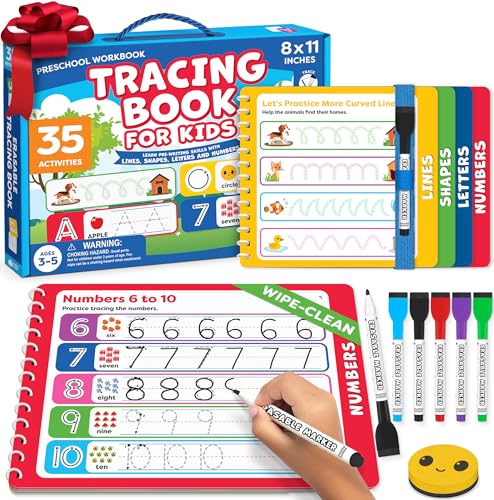
From Momo & Nashi, this all-in-one tracing kit adds color, lines, shapes, and letters into one accessible set. The included dry-erase markers and storage box support repeated practice, which is essential for reinforcing fine motor skills and letter formation. The varied activities help children progress from tracing letters to more complex writing tasks, suitable for homeschool or classroom use.
School Zone Big Preschool Workbook

With more than 300 activities across 320 pages, this workbook covers writing, colors, shapes, basic phonics, and early math. The breadth of content supports a well-rounded approach to prek readiness, making it a staple for families seeking consistent practice in a single resource. The large format can be beneficial for small-group or individual work sessions.
Preschool Learning Activities Educational Workbook

MORECOLL’s workbook focuses on 62 reusable pages, offering 16 activities that cover tracing, numbers, letters, and early math concepts. The kit includes dry-erase markers, rings, and a storage bag for organization, making it adaptable for ongoing practice. It is presented as a flexible resource for diverse learning environments, including homeschooling and classroom centers.
Buying Guide: Key Purchase Considerations
When choosing alphabet materials for kids, consider the following perspectives to ensure the best fit for your learner and setting.
- Learning goals: Decide between tracing-centric workbooks, dot-to-dot activities, or all-in-one activity sets. For foundational handwriting, tracing-focused books are ideal; for engagement, dot-to-dot tasks and colorful activities can sustain interest.
- Age and readiness: Confirm the recommended age range and ensure difficulty aligns with the child’s current skills. Too-simple tasks may cause frustration, while overly advanced pages can hinder confidence.
- Format and durability: Look for spiral or reusable formats with dry-erase features for long-term use. Durable pages and secure storage accessories help support repeated practice and easy cleanup.
- Teacher and caregiver support: Consider resources that offer clear progress cues, checklists, or guidance to track letters and handwriting milestones.
- Home versus classroom use: For group settings, a workbook with many activities in one could streamline lesson planning. For home use, portability and ease of access are key factors.
- Non-toxic and safety considerations: Ensure materials are child-safe, especially for younger learners who frequently put items in their mouths.
- Alignment with early literacy standards: Materials should support letter recognition, order, writing strokes, and basic phonics to complement reading development.
- What to buy first: For beginners, a tracing-focused workbook paired with a dot-to-dot option offers a balanced start. Add a reusable, dry-erase resource for independent practice and ongoing review.
- Progress tracking: Choose products that provide clear milestones, so caregivers can gauge improvement in letter formation and fine motor skills.
- Flexibility: Reusable kits and storage-friendly designs support ongoing practice without creating clutter.